
EXPEDITION OVERVIEW
STATUS
SUMMITED
EXPEDITION YEAR
2026
THE ORIGINAL PLAN
Lhotse was never supposed to be a separate expedition.
The original objective was much bigger.
Everest. Lhotse. Nuptse.
Three mountains linked together in a single push through the Western Cwm.
On May 21, I stood on the summit of Everest.
The plan was to descend to the South Col, recover briefly, move across to Lhotse Camp 4 and continue directly into the second half of an Everest–Lhotse double.
But the descent from Everest had already become complicated.
After everything that happened high on the mountain, I eventually ran out of oxygen around the Balcony and had to descend the rest of the way to Camp 4 without it, stopping every fifty or hundred meters to recover.
By the time I reached the South Col, I was exhausted.
I ate some noodles and crawled into the tent at around 5pm.
There was no oxygen running while I slept.
I woke at around 8am the following morning.
I was tired, but the plan hadn’t changed.
Lhotse was next.
WHERE'S THE OXYGEN?
We left Everest Camp 4 and descended toward Lhotse Camp 4.
Around twelve oxygen bottles had been cached there for our team.
When Pechhumbe and I arrived, something didn’t look right.
Roughly five of the bottles were missing.
Stolen.
We were only about fifty meters above camp when Nawang came over the radio asking where the rest of the oxygen was.
The original climbing teams were me with Pechhumbe, and Victor with Nawang.
I personally had enough oxygen to continue.
But Victor didn’t.
We’d climbed together through South America and Manaslu, and I wasn’t prepared to simply leave him behind and continue to the summit because my bottles happened to still be there.
We searched the surrounding tents.
We asked other teams.
We looked for any spare oxygen we could find.
There wasn’t enough.
At the same time, the forecast was deteriorating. Winds of 70, 80 and potentially 100 kilometres per hour were approaching.
Eventually there was only one sensible decision.
We turned around.
Instead of continuing to the summit of Lhotse, we descended all the way back to Camp 2.
The Everest–Lhotse double was over.
But I wasn’t finished with Lhotse.
BACK UP
At Camp 2, we had replacement oxygen cached.
The obvious option would have been to call it.
I’d already summited Everest. I’d been above 6,500 meters for days. I was tired, losing weight and the entire spring season had already included Annapurna and Makalu.
But Lhotse was right there.
So we waited for another opportunity.
The delay ultimately kept me high on the mountain for roughly another six days.
Victor wasn’t able to join the second attempt.
This time it would be Pechhumbe and me.
When the weather finally gave us another chance, we moved fast.
We left Camp 2 at around 7am and climbed the Lhotse Face toward Everest Camp 3.
It took us roughly ninety minutes.
We reached Camp 3 somewhere around 8:30 or 9am and spent most of the day there resting.
The sun on the Lhotse Face was intense.
At one point I was sitting in the tent stripped down to my underwear trying to stay cool.
On the lower mountain I was still using my Arc’teryx Beta shell and Mountain Hardwear softshell pants, but in the sun at Camp 3 even those were too much. Once we moved higher that evening, I transitioned back into my Kailas 8,000-meter summit suit for the colder upper mountain.
At around 4pm, we started climbing again.
Camp 3 to Lhotse Camp 4 meant another six or seven hours of climbing through the Lhotse Face and Yellow Band.
I did the entire section without supplemental oxygen.
We reached Camp 4 at around 10pm.
There was barely enough time to stop.
A couple of hours later, we were leaving for the summit.
BY MOONLIGHT
We left Lhotse Camp 4 sometime around midnight.
I started using supplemental oxygen there, initially at around one litre per minute before increasing it higher on the mountain.
Pechhumbe and I were the first team out.
I was climbing in my La Sportiva Olympus Mons Pro with Petzl Sarken crampons, clipped into the fixed lines with my Blue Ice harness and Petzl ascender, with my Petzl Sum’Tec in hand. I was already in my summit suit, with my Mountain Hardwear Absolute Zero mitts ready for the colder sections higher up.
Nobody had climbed Lhotse for several days, so there was fresh snow on the route and sections where we had to break trail.
The night was completely clear.
My Petzl Actik Core had been lighting the route, but the moon was so bright that we genuinely didn’t need it for sections of the climb. Higher up, I switched into my Julbo Lightyear OTG goggles as we moved toward the steeper, more exposed upper couloir.
It was one of the most surreal nights I’ve experienced on a mountain.
By around 3am we were somewhere between 8,100 and 8,200 metres.
We were moving too quickly.
If we continued at that pace, we’d reach the summit in darkness.
So we stopped.
For almost an hour, high in the death zone, we waited for daylight.
Then we started moving again.
Above us was the Lhotse Couloir.
It was steeper and more technical than anything I’d encountered on Everest.
There were buried ropes, avalanche and rockfall exposure, and almost constant steep climbing.
There wasn’t one single crux.
The difficulty was that it never really let up.
By this point we’d already climbed more than 2,000 vertical metres since leaving Camp 2 the previous morning.
And we still weren’t at the summit.
8,516 METERS
As daylight arrived, the conditions became almost impossibly good.
Clear sky.
No wind.
Full sun.
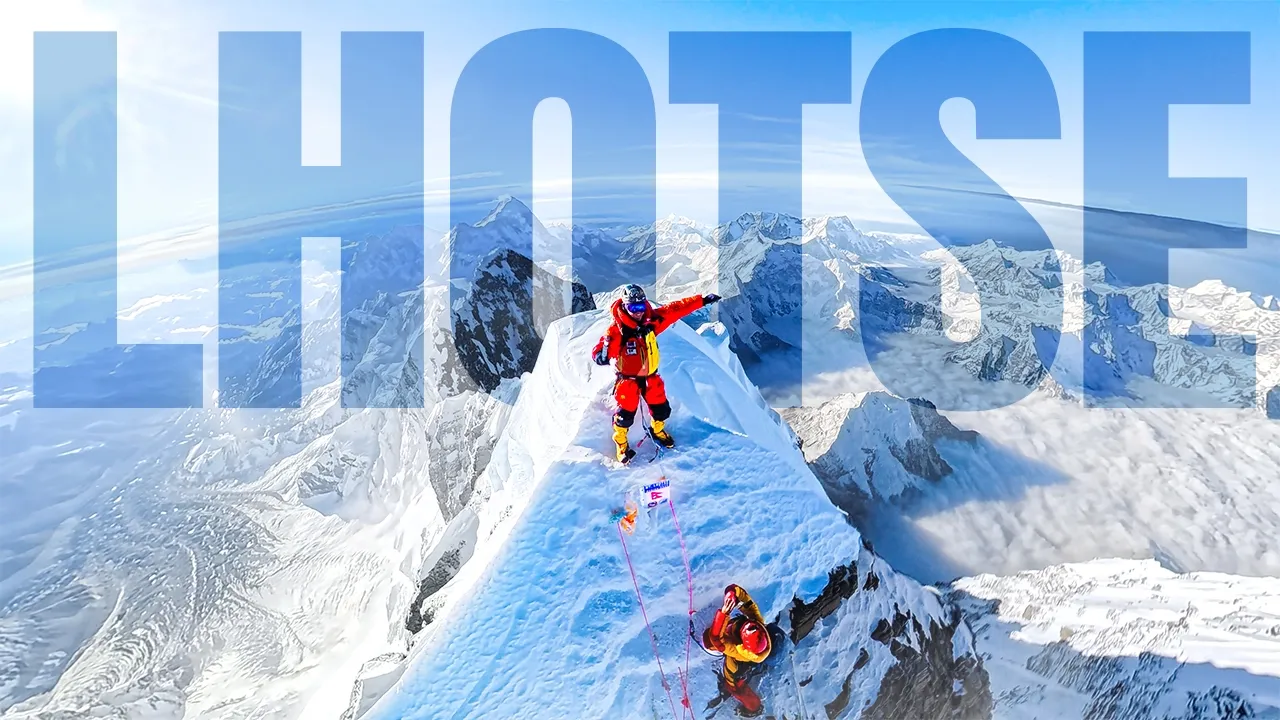
After the steep climbing through the couloir, Pechhumbe and I reached the summit at around 7:30am on May 27.
8,516 meters.
For the first twenty minutes, we had the summit completely to ourselves.
Six days earlier I’d been standing on top of Everest.
Now I was standing on the fourth-highest mountain in the world.
And this summit felt completely different.
The weather was so calm that I took my gloves off, opened my down suit and removed my oxygen mask.
We could see Everest beside us, climbers moving along its route, Makalu in the distance and Nuptse below.
Looking down, I could trace the route through Camp 4, Camp 3 and Camp 2 that we’d climbed in a single push.
We stayed on the summit for almost an hour.
With the weather so calm, I had plenty of time to film the summit properly with my DJI Osmo Action 6 and Insta360 X5, capturing Everest beside us and the route we’d just climbed below.
Of all the 8,000-meter summits I’d experienced, Lhotse had the best conditions.
It was my fifth 8,000-meter summit.
My fourth that spring.
And after everything it had taken to get back there, this one felt earned.
ONE LAST WARNING
Eventually, we had to leave.
The descent from the summit to Lhotse Camp 4 took roughly two and a half to three hours.
It was fast, but the couloir was becoming increasingly busy as other teams climbed toward us.
Rock and snow were being knocked down from above.
Then something much more dangerous came flying past.
A full oxygen bottle.
Someone from a team thirty or fifty meters above us had lost it.
The bottle accelerated down the couloir and flew past Pechhumbe and me.
Somehow, it missed everyone.
Of all the moments on Lhotse, that was probably the one that scared me most.
It was a reminder that even in perfect weather, even after reaching the summit, the mountain can still find ways to hurt you.
We reached Camp 4 around 9:30 or 10am and helped pack some of the 8K tents before continuing down.
By around midday we were back at Camp 3.
The heat returned.
We rested, then continued down the Lhotse Face toward Camp 2.
We finally arrived around dusk, somewhere near 6pm.
By then we’d effectively been awake and moving for around thirty-six hours.
PERSEVERANCE
The following morning, we left Camp 2 shortly after 6am.
One final descent through the Khumbu Icefall.
We reached Everest Base Camp at around 10am.
The season was ending around us.
Base Camp was already being dismantled. My own tent was gone.
I found some Coke, ate some noodles and, about forty-five minutes later, climbed into a helicopter and left.
The original plan had been Everest, Lhotse and Nuptse.
The stolen oxygen changed everything.
The delay cost us almost a week and meant Nuptse was no longer possible before the Khumbu Icefall closed for the season.
On paper, the Everest–Lhotse double hadn’t happened the way we’d planned.
But in hindsight, I’m glad it didn’t.
If everything had gone perfectly, Lhotse might have become little more than another summit tagged onto Everest.
Instead, we had to retreat.
Replace the oxygen.
Wait.
Climb the Lhotse Face again.
Go back through the Yellow Band.
Return to Camp 4.
And start all over.
By the time I left Nepal, I’d lost around eight kilograms and had mild frostbite in my toes.
I was exhausted.
But I’d arrived that spring with one 8,000-meter summit.
I was leaving with five.
Annapurna.
Makalu.
Everest.
Lhotse.
Added to Manaslu the previous year, the fourteen-peaks objective suddenly looked very different.
Lhotse wasn’t the mountain that went according to plan.
It was the mountain we refused to give up on.
Lhotse was perseverance.
MOUNTAIN DETAILS
ALTITUDE
8,516
M
COUNTRY / REGION
Nepal / China
ROUTE
Normal Route
OPERATOR / GUIDE
8K Expeditions
CONTINENT
Asia
MOUNTAIN RANGE
Himalaya
https://youtu.be/YpmlRBd8vhQ
