
EXPEDITION OVERVIEW
STATUS
SUMMITED
EXPEDITION YEAR
2026
SUPPLEMENTAL OXYGEN
WITH O2
THE BIG ONE
Makalu was never the end goal.
It was another step toward the mountain I'd dreamed about climbing since I was a kid.
Everest.
I'd summited Annapurna on April 18 and Makalu on May 3. By the time we flew out of Makalu Base Camp, I was exhausted, several kilograms lighter and starting to deal with frostbite in my left big toe.
The original plan was to spend a few days around Namche before heading to Everest Base Camp.
Then the weather gave us more time.
So the morning after leaving Makalu, Victor, Saeid and I flew from Base Camp to Dingboche, then Lukla and finally back to Kathmandu.
What was supposed to be five or six days became eight.
And I needed every one of them.
We ate. Slept in real beds. Spent time in saunas and hot jacuzzis trying to warm my toe. And consumed a ridiculous amount of Fire and Ice pizza.
The winds on Makalu had also destroyed our faces. All three of us returned to Kathmandu badly windburned, and over the following days the skin basically peeled away.
We looked like we had some kind of disease.
But slowly everything started healing.
Eight days later, it was time to go back into the mountains.
This time for the big one.
NO ROTATIONS
Most Everest expeditions spend weeks acclimatizing on the mountain.
I didn’t need to.
Annapurna and Makalu had been my Everest rotations.
When I flew into Everest Base Camp at around 5,700 metres, I was already fully acclimatized.
We spent only two or three nights there before beginning the summit push.
I felt great.
By now, Victor and I had become a team. Saeed was also with us at Base Camp, although he’d already climbed Everest and was there to climb Lhotse.
I was paired with a new Sherpa, Pachhumbe. Ashok, who I’d climbed Annapurna and Makalu with, had been assigned to a large Ukrainian team.
Pachhumbe didn’t speak much English, but that didn’t matter much.
He was strong.
He could keep up.
And we worked well together.
The objective was also bigger than simply Everest.
The plan was:
Everest → Lhotse → Nuptse.
A lot of climbers attempting the three mountains start with Nuptse.
I deliberately wanted to do the opposite.
I’d invested too much time, money and effort into the expedition to risk something happening on Nuptse and losing my opportunity on Everest.
Everest was the priority.
Lhotse was second.
If the mountain and the clock allowed it, Nuptse would come last.
First, we had to get through the Khumbu Icefall.
THROUGH THE ICEFALL
We left Everest Base Camp sometime around midnight or 1am.
The objective was Camp 2.
I had somewhere around 20 to 25 kilograms on my back, carried in my Hyperlite Halaka 55, but after Annapurna and Makalu, the Khumbu Icefall felt surprisingly straightforward.
I was climbing in my La Sportiva Olympus Mons Pro with Petzl Sarken crampons, using my Blue Ice harness, Petzl ascender and Black Diamond Vapor helmet through the fixed sections.
We moved quickly.
We didn’t even stop at Camp 1.
Instead, we continued through the Western Cwm and reached Camp 2 sometime around 6 or 6:30am.
What I remember most wasn’t the Icefall.
It was the cold.
I was still wearing Mountain Hardwear softshell pants, Smartwool layers, a light down jacket and my Arc’teryx Beta shell rather than my summit suit.
During that final hour into Camp 2, I was absolutely freezing.
My fingers and toes were numb and I was shivering, but we were close enough that I didn’t want to stop and unpack the Kailas 8,000-meter summit suit.
When I finally walked into the dining tent, someone handed me a hot tea.
I immediately asked for another.
One for each hand.
The funny thing about Everest was how quickly conditions could flip.
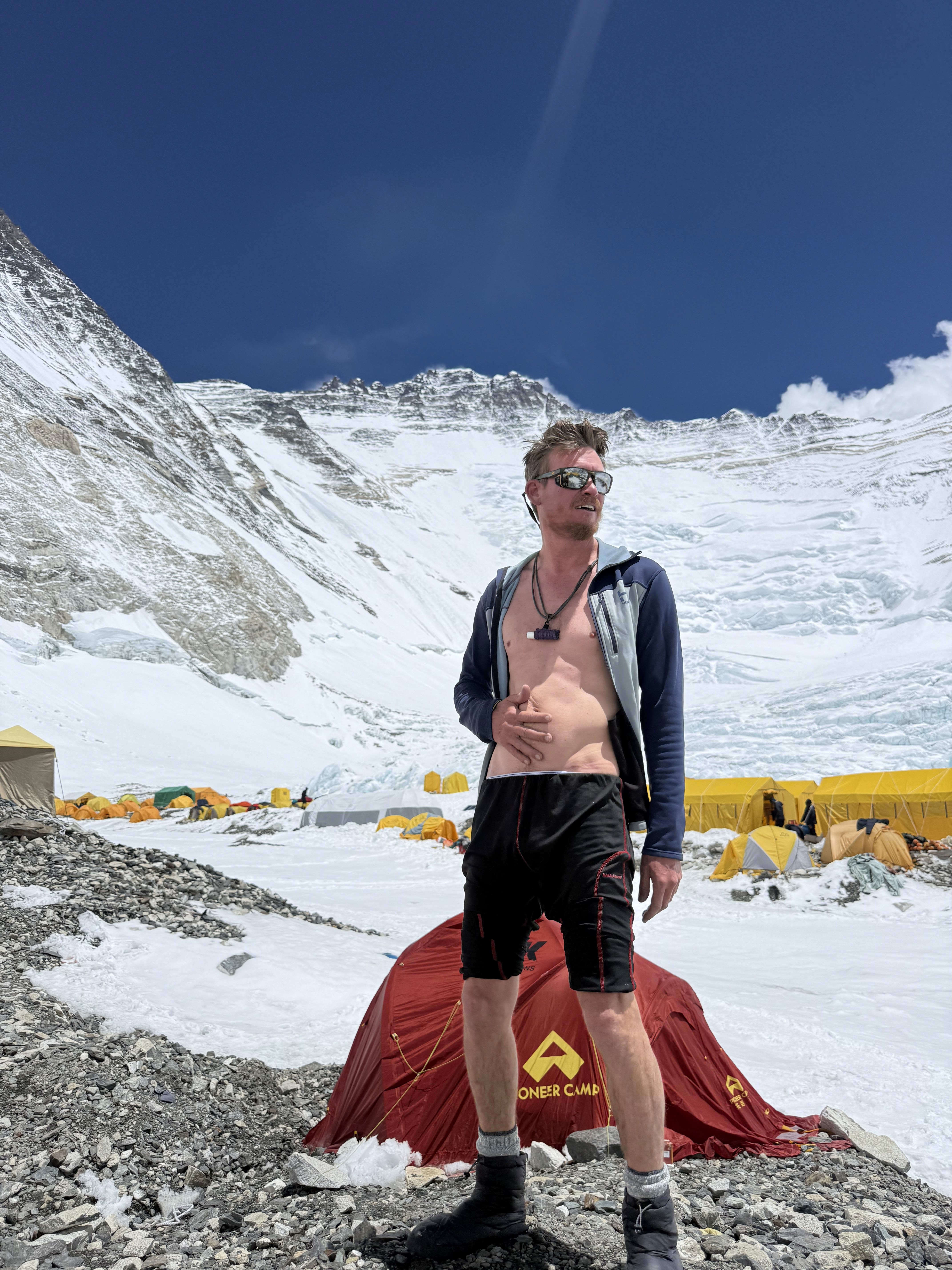
Once the sun came up over the Western Cwm, it could become unbelievably hot. On the glacier we were often stripping down to base layers, sometimes even sitting around in our underwear, because the heat reflecting off the snow was so intense.
The original plan was to spend one night at Camp 2.
Then we looked at the mountain.
Almost everyone seemed to be moving on the same schedule.
Rather than join them, we waited.
The following day would become the busiest summit day Everest had ever seen.
We deliberately stayed behind at Camp 2 and let the crowds move ahead.
Then we started climbing again.
THE SOUTH COL
We left Camp 2 at around 6am.
By 9 or 10am, we had reached Camp 3.
The route begins fairly gradually before reaching the Lhotse Face, where the climbing turns into several hundred meters of steep jumaring on the fixed lines.
I was still climbing without supplemental oxygen.
Camp 3 presented the opposite problem to the freezing approach into Camp 2.
It was unbelievably hot.
Once the sun hit the tents, they turned into ovens. Victor and I were sometimes stripped down to our underwear just trying to cool off. My Julbo Shield sunglasses were particularly useful on those long, bright days on the glacier, where the sun reflecting off the snow could be relentless.
My Garmin Fenix 8 was also constantly on my wrist through the push, giving me altitude, heart rate and a running measure of how long we’d been moving.
We spent the night at Camp 3 before continuing toward the Yellow Band early the following morning.
By then, we were beginning to catch the climbers we’d deliberately allowed to move ahead of us.
Overtaking on fixed ropes isn’t always straightforward. Sometimes you wait for someone to stop. Sometimes you ask to pass.
And sometimes an opportunity appears, you unclip, move around them and keep climbing.
Eventually, we worked our way through most of the traffic.
Around noon or 1pm, we reached Lhotse Camp 4 and ran into Saeed descending from the summit of Lhotse.
He had just completed the five highest mountains in the world.
A high five.
A big hug.
A quick celebration.
Then he continued down.
And we kept going up.
Around Lhotse Camp 4, I finally started using supplemental oxygen to conserve energy for the summit push.
We reached the South Col at around 3pm.
The scale surprised me.
Tents everywhere.
Climbers everywhere.
Sherpas moving constantly through camp.
Organized chaos at nearly 8,000 meters.
Victor had arrived shortly before me.
Another friend, Cris from Train to Summit, had just returned from the summit. I found his tent, congratulated him and listened carefully while he told me about the crowds and conditions higher on the mountain.
Then I went back to my tent.
I had about six and a half hours.
Drink.
Eat.
Rest.
At 9:30pm, I clipped into the line and started climbing toward the highest point on Earth.
A LINE OF HEADLAMPS
From the tents at the South Col, we could see the route stretching away above us.
A seemingly endless line of headlamps climbed into the darkness.
Knowing we were about to join it was slightly demoralizing.
Victor had left several hours earlier. Pachhumbe and I clipped in at around 9:30pm.
By then I was fully geared for the summit: Kailas 8,000-metre summit suit, Mountain Hardwear Absolute Zero mitts, Julbo Lightyear OTG goggles, and my Petzl Actik Core lighting the route in front of me.
For the first hour, we accepted our place in the line.
Then I realized we were moving far too slowly.
I told Pachhumbe we needed to go.
Whenever an opportunity appeared, we overtook.
By the time we reached the Balcony at around 2am, we’d passed much of the traffic.
Most climbers stopped there to rest, eat, drink and change oxygen bottles.
I still felt strong.
My oxygen was good.
I’d carried my usual one-litre Nalgene and Thermos Light 1L with a hot drink, but I didn’t want to stop for long and allow everyone we’d just passed to catch us again.
So we kept moving.
Somewhere around the Balcony, we passed Victor.
Higher on the mountain, the darkness slowly began to disappear.
At around 4 or 4:30am, the first glow of sunrise appeared.
Makalu stood behind us.
Far below, lightning flashed through thunderstorms in the distance.
Above us was the South Summit.
We kept climbing.
TOP OF THE WORLD
At the South Summit, the crowds began building again.
We changed oxygen bottles, cached the empties for the descent and dropped onto the final summit ridge.
There wasn’t much room to overtake anymore.
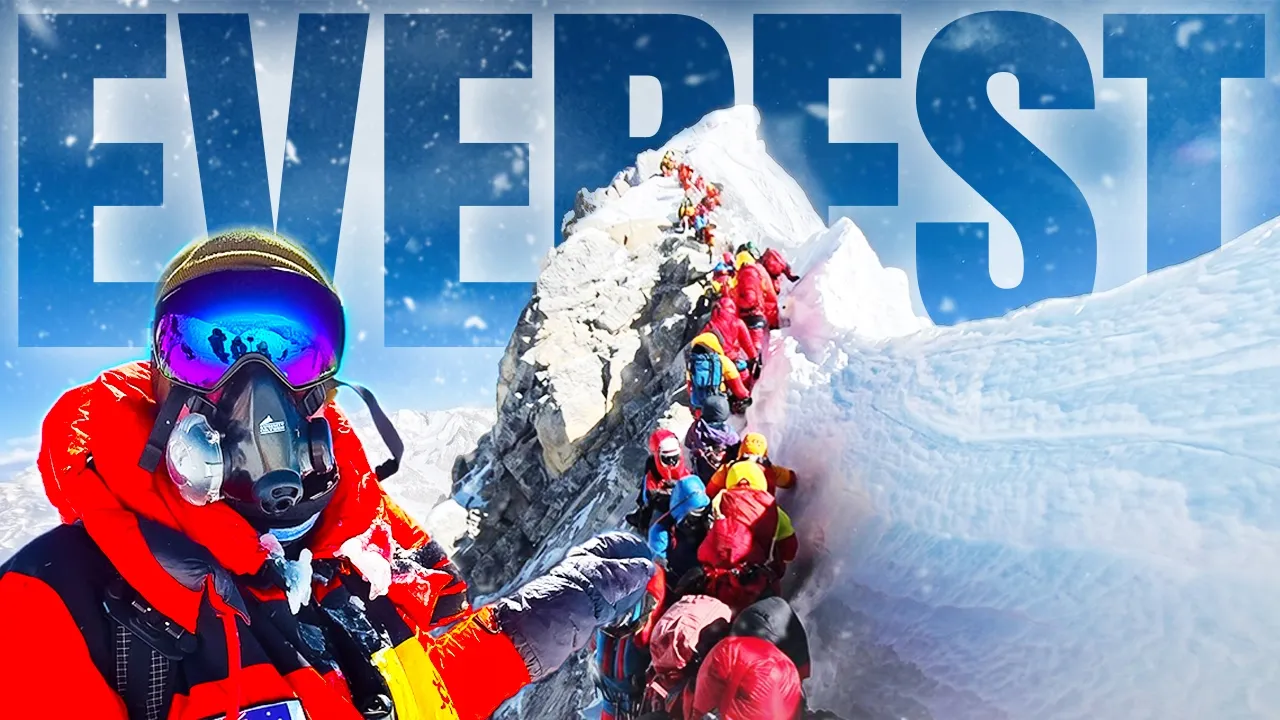
Then we reached the Hillary Step.
Climbers were trying to move in both directions and several people ahead were struggling with the terrain.
We waited for around ten minutes.
Then Pachhumbe looked at me.
Let’s go.
We moved around the group and climbed through the section without waiting for the fixed line.
It got us into open space.
Then I saw it.
The true summit.
Maybe fifty or a hundred metres away.
For the first time that morning, I knew with certainty that I was going to stand on top of Everest.
That moment hit me harder than I expected.
I’d had photographs and posters of Everest on my bedroom wall since I was a kid.
Now there were only a few metres left.
There may have been a few tears hiding behind my Julbo Lightyear OTG goggles.
When we arrived, around twenty climbers were finishing their photos.
Within five minutes, they were gone.
Suddenly it was just Pachhumbe and me.
Alone on the summit of Mount Everest.
For those few minutes, there was nobody higher anywhere on Earth.
The sky was completely blue. Winds were maybe 20 or 30 kilometres per hour, but the visibility was incredible.
Lhotse stood behind us.
Makalu was off to the left.
The Himalayas disappeared toward the horizon.
We spent roughly twenty to thirty minutes taking photographs, filming and trying to absorb where we were.
I was documenting the summit with my DJI Osmo Action 6 and Insta360 X5, the same two cameras I’d been carrying through the spring — trying to capture something I’d imagined since I was a kid.
Eventually other climbers began arriving.
It was time to go.
Everest had been a childhood dream.
Now I’d done it.
8,744 METERS
The descent immediately brought the crowds back.
At the Hillary Step, it was chaos.
Around a hundred climbers and Sherpas seemed to be trying to move in both directions on the same rope.
Rather than wait, Pachhumbe and I climbed around the outside and continued toward the South Summit.
I passed Victor just before the Hillary Step.
A hug. A high five.
He was struggling, but he was nearly there.
Then, approaching the South Summit, I noticed another climber ahead of me.
Three climbers were yelling at him because he was moving slowly.
At first, I thought they were simply being impatient.
Then I realized something was wrong.
He wasn’t clipped into the fixed line.
He was unstable on his feet.
I hurried toward him, grabbed him and asked if he was okay.
He mumbled something.
Then collapsed into my arms.
I sat him down and immediately clipped his tether into the fixed line.
We were at approximately 8,744 metres.
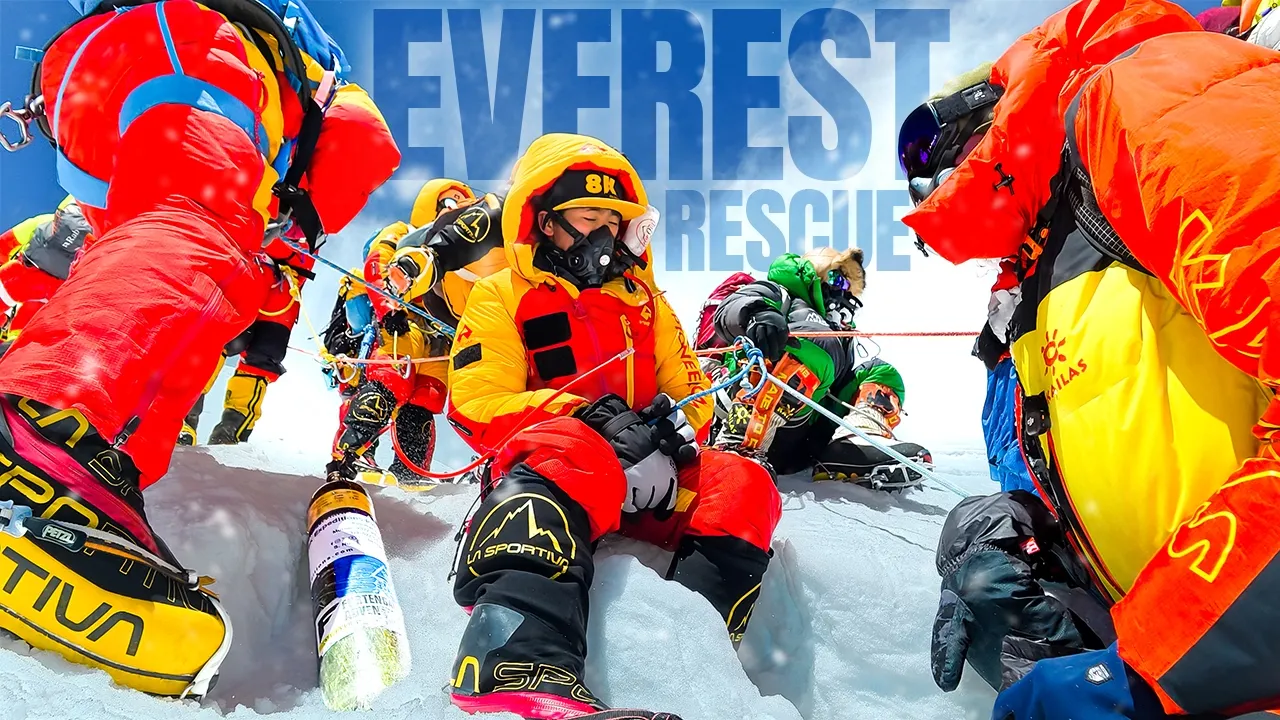
His name tag read 8K Pemba D Sherpa.
He was one of ours.
His oxygen bottle wasn’t empty.
The problem was his mask.
The exhaust valve had completely frozen over with ice. Instead of allowing his exhaled gases to escape, the mask was trapping them.
He was barely conscious.
Pachhumbe arrived several minutes later and together we tried to clear the frozen exhaust.
Occasionally we’d get it working enough for Pemba to receive fresh oxygen.
He’d begin coming around.
Then fade again.
I remembered Nawang, Victor’s Sherpa, had packed a spare mask.
We radioed him.
He and Victor were still near the summit.
So we waited.
For the better part of two hours, we remained there with Pemba while climbers continued passing around us.
Eventually Nawang arrived with the spare mask.
The effect was almost immediate.
Pemba began coming back.
By then several Sherpas had gathered around us.
Nawang looked at me.
“Our Sherpa brothers are here now. We’ve got this. You can go.”
I gave Pemba a pat on the back.
Then I started descending alone.
EVEREST
Stopping for nearly two hours at 8,744 metres had a consequence.
Oxygen.
I’d had the presence of mind to turn my flow rate almost all the way down while we were helping Pemba.
That bought me time.
Once I started descending again, I turned it back up and moved quickly toward the Balcony.
But I knew the bottle wasn’t going to last.
Not long below the Balcony, it emptied.
I was somewhere around 8,200 or 8,300 metres.
It wasn’t an emergency.
But everything became painfully slow.
Stand up.
Descend fifty metres.
Sit down.
Breathe.
Wait three or five minutes.
Stand up.
Do it again.
A section that might normally have taken an hour took closer to three.
Eventually I reached the South Col sometime around 3:30 or 4pm.
There wasn’t a celebration.
I was destroyed.
I ate some noodles, drank as much as I could and crawled into the tent.
Time for reflection came later.
And with time, my feelings about Everest have become complicated.
The mountain itself isn’t particularly technical compared with some of the other 8,000ers I’ve climbed.
What concerned me more was the number of people attempting it without the experience I believe these mountains demand.
Everest is still the highest mountain on Earth.
It is well inside the death zone.
If the weather changes, a climber loses the fixed line or becomes separated from their Sherpa, the consequences can become serious very quickly.
Seeing that up close changed the way I looked at Everest.
But it doesn’t change what standing on the summit meant to me.
For a few minutes, Pachhumbe and I had the highest point on Earth entirely to ourselves.
A mountain that had been on my bedroom wall as a kid was underneath my boots.
A childhood dream was complete.
And Everest became another major step toward two much bigger objectives:
The Seven Summits.
And all fourteen 8,000-metre peaks.
People still ask me one question more than almost any other when they find out I’m a mountaineer:
“Have you climbed Everest?”
Now I can say yes.
FIELD NOTES / PHOTOGRAPHS
FROM THE EXPEDITION

EBC
Base Camp Views
Views of Base Camp the day before we left EBC to start our push
Everest Camp 2
C2 is formal attire only
up on the glacier the day time temps reach into the high 30's so you can often see us hanging out in our underwear. I was on my way to lunch when this picture was taken

Camp 3
Everest Camp 3 from the skies
This is Camp 3 we only spent a few hours here on our push upwards.

Everest C4
Taking a break...
On the final few meters into C4

Everst Balcony (ish)
Always moving up
Taken shortly after passing The Balcony as we make our way up to the South Summit

South summit
Sunrise at 8,500m
It's 4am and the sun is just starting to rise. warmth is finally coming. We're at 8,500m just below the South Summit.

Summit ridge
Traffic Jam at 8,700m!
At some points the lines were crazy and all we could do is wait

Hillary Step
Bottle Neck at Hillary Step
This was a true traffic jam. Luckily we were able to move past some slower climbers and find some clear space shortly after.

Everest Summit
My first view of the summit!!
Tear were definetly fogging up my goggles at this point. We had made it.

Everest Summit
The Sign

Everest Summit
Summit Brothers
Pechhumbe and I on the summit. this was the best picture we got together 🤣

Descending
Heading down?
This part of the descent was much more chilled. Even had some time to take in the views.
Camp 2
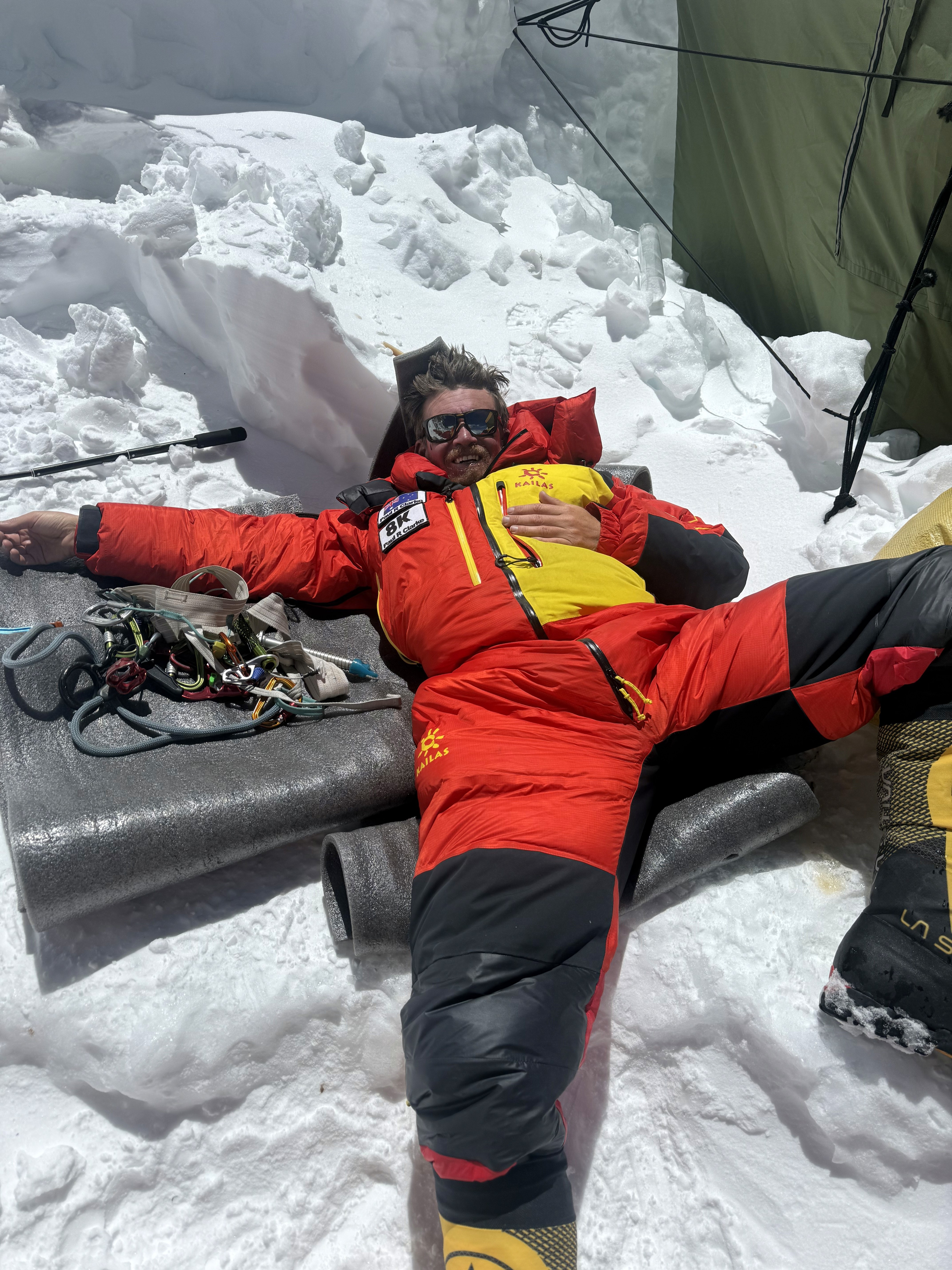
Pooped
Safe back in C2 after a few big days.
MOUNTAIN DETAILS
ALTITUDE
8,848
M
COUNTRY / REGION
Nepal / China
ROUTE
South Side. Souteast Ridge.
OPERATOR / GUIDE
8K
CONTINENT
Asia
MOUNTAIN RANGE
Himalaya
https://youtu.be/YpmlRBd8vhQ
