EXPEDITION OVERVIEW
STATUS
SUMMITED
EXPEDITION YEAR
2026
TRAINING FOR EVEREST
By the time we reached Argentina, this trip had become about much more than ticking off individual mountains.
Everest was locked in for the spring, and the plan developing around it was ambitious. I wanted to arrive in Nepal capable of moving efficiently at altitude, recovering quickly between climbs and handling long days without completely destroying myself. With the possibility of attempting four 8,000-meter mountains in less than 60 days, fitness and recovery were going to matter just as much as climbing ability.
My approach to training was pretty simple: climb mountains. Lots of them.
Victor and I had already spent weeks moving through Ecuador, climbing and acclimatizing, before heading to Chile for Ojos del Salado. We summited mountains, came down, recovered for a day or two and went again.
Now we were heading for the biggest objective of the South American trip.
Aconcagua. 6,961 meters. The highest mountain outside Asia.
THREE DAYS
We arrived in Mendoza exhausted.
Only days earlier we'd been high on Ojos del Salado in Chile. After descending, we'd driven through the night back to Copiapó, flown through Santiago and eventually made our way across to Argentina.
For once, we actually stopped.
We checked into the Sheraton in Mendoza and gave ourselves roughly three full days to eat, sleep, reorganize our gear and sort out permits and logistics for Aconcagua.
But there was another reason we couldn't hang around.
The weather forecast showed a small summit window. February 2 looked good, blue skies and relatively light winds, but after that the mountain was forecasted to deteriorate, with significant snow and poor conditions potentially shutting things down for weeks.
We were already well acclimatized.
We felt strong.
So rather than slowly working our way up the mountain and potentially missing the window, we decided to move.
Fast.
INTO THE MOUNTAIN
We entered Aconcagua carrying relatively light packs, with our heavier equipment sent ahead by mule.
The first stop was Confluencia.
The following morning Victor left around 3 a.m. I knew I'd move faster, so I gave him a couple of hours and left around 5.
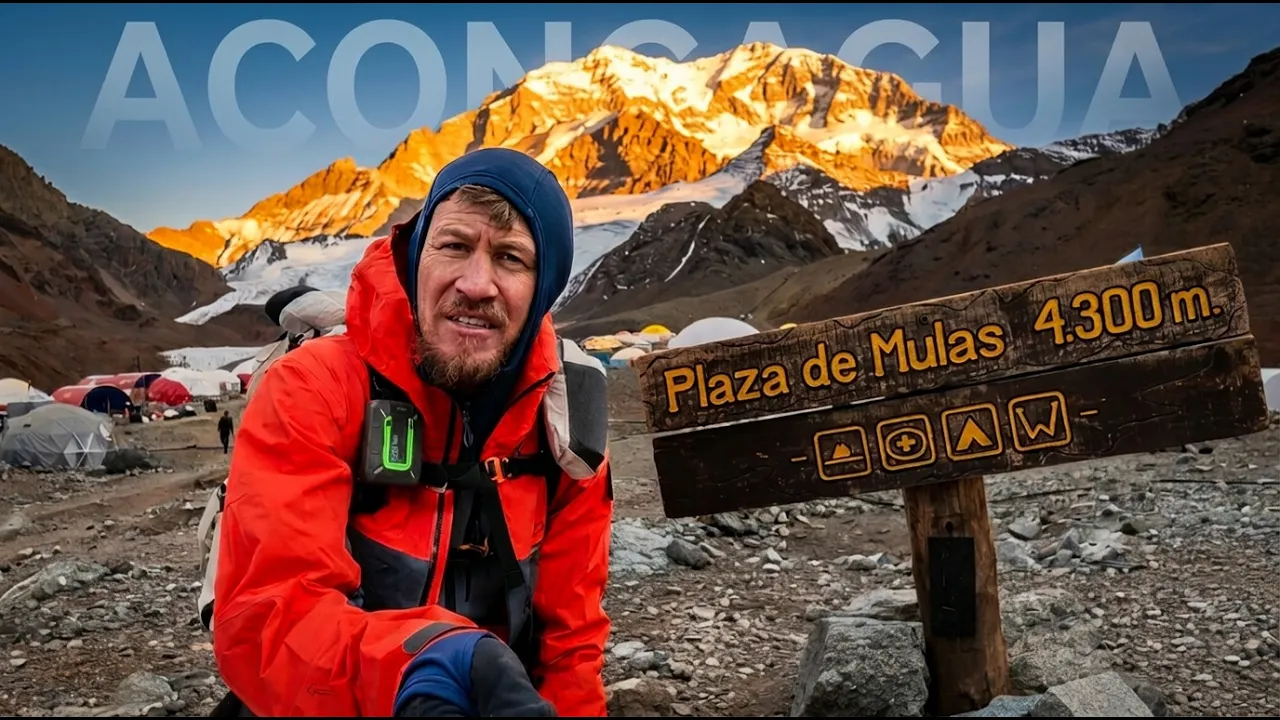
The approach toward Plaza de Mulas is mostly straightforward valley walking before climbing more steeply toward Base Camp. I eventually caught Victor late that morning, around the same time our mule bags started overtaking us.
We walked into Plaza de Mulas together at around 11:15.
After checking in with the park authorities, we collected our bags and went through the Base Camp medical check. The doctor was understandably a little surprised when we explained that we weren't planning on spending several days acclimatizing there.
We wanted to keep climbing.
Our recent time at altitude meant our bodies were already well adapted, and after checking us over, the doctor was comfortable with us continuing.
So we repacked our gear and at around 3 p.m. left Base Camp.
That evening we reached Camp Canada, pitched the tent on what turned out to be a slight slope, ate dinner and tried to sleep.
I spent most of the night slowly sliding down the tent and basically cuddling Victor.
Not exactly luxurious expedition living.
CHASING THE WINDOW
The next morning was cold enough that neither of us was particularly enthusiastic about getting out of the tent.
We were awake early but didn't actually start moving until around 10 a.m.
As we climbed toward Camp two, Nido de Cóndores, the weather deteriorated.
Cloud rolled across the mountain until eventually we were climbing in near-whiteout conditions.
At Nido we checked the latest forecast with the park staff. We knew February 2 was still supposed to be our window, so we kept going.
We climbed through the cloud toward camp Berlin and then eventually put our crampons on for the final section toward Camp Cólera.
I reached camp roughly an hour ahead of Victor and immediately started setting up the tent and collecting snow to melt.
The weather wasn't particularly reassuring.
But the forecast still said tomorrow was the day.
Missing that window could mean descending all the way back to Plaza de Mulas and waiting potentially another week or more.
So we ate, crawled into our sleeping bags and set the alarm for 3 a.m.
BREAKING TRAIL
The alarm went off at 3 a.m.
And the mountain was silent.
Fresh snow had fallen overnight, but nobody seemed to be moving.
I had absolutely no interest in being the first person out there breaking trail in the dark, so we made the highly technical mountaineering decision to go back to sleep.
Around 5 a.m., we finally started hearing movement outside.
Time to go.
We got ourselves ready, dealt with an issue with Victor's boots and eventually left somewhere around 5:30 or 6 a.m.
A commercial team was ahead of us.
Perfect.
Except we caught them almost immediately.
We passed them, and suddenly the plan of letting somebody else break trail wasn't working particularly well.
From there, we were out front.
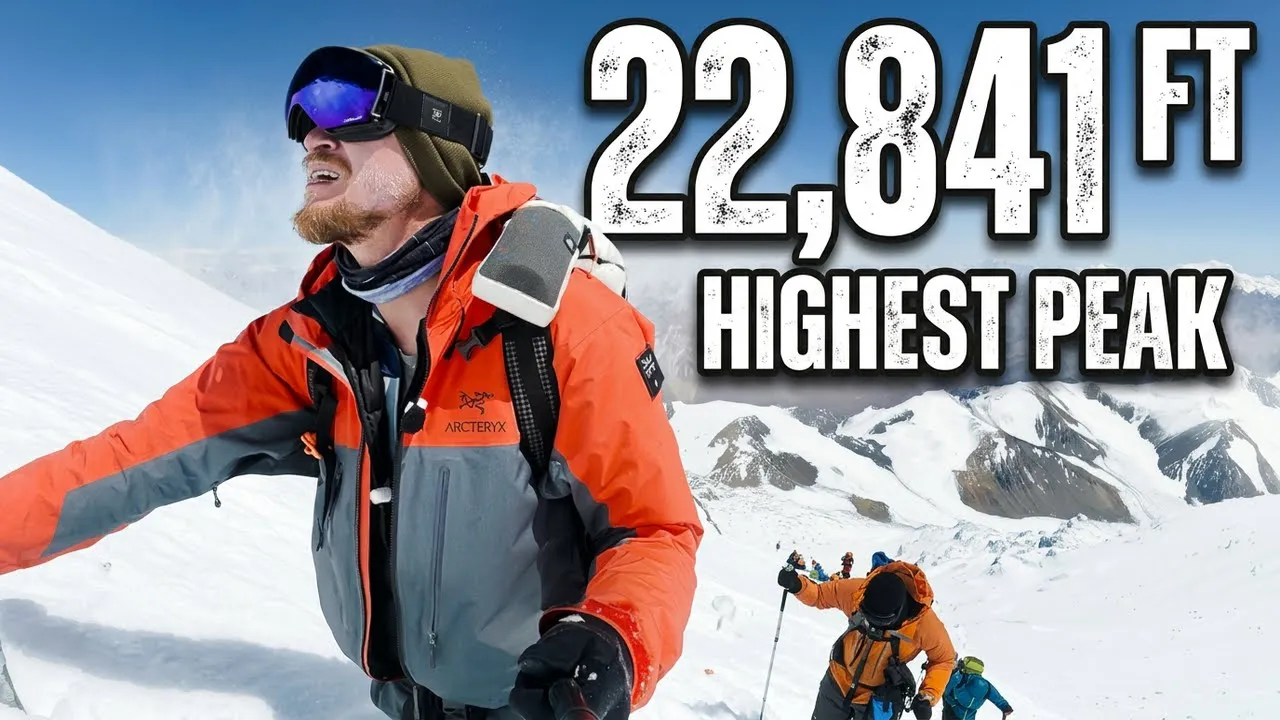
Fresh snow covered much of the route, sometimes reaching around mid-calf. But neither of us was complaining. Aconcagua is notorious for loose scree, and in many ways the snow made climbing more enjoyable.
We just kept moving upward.
6,961 METERS
Higher on the mountain, the altitude finally started to make itself felt.
I didn’t have a headache or feel sick. I was just slow.
Every step required more effort. Breathing became harder and the pace dropped.
Victor and I had spent much of the climb moving independently but always within sight of one another. I would normally get a few hundred meters ahead, stop and let him close the gap, then continue.
Near the summit, we came back together.
The fresh snow had covered much of the notorious loose terrain near the top, and we continued climbing toward the final ridge.
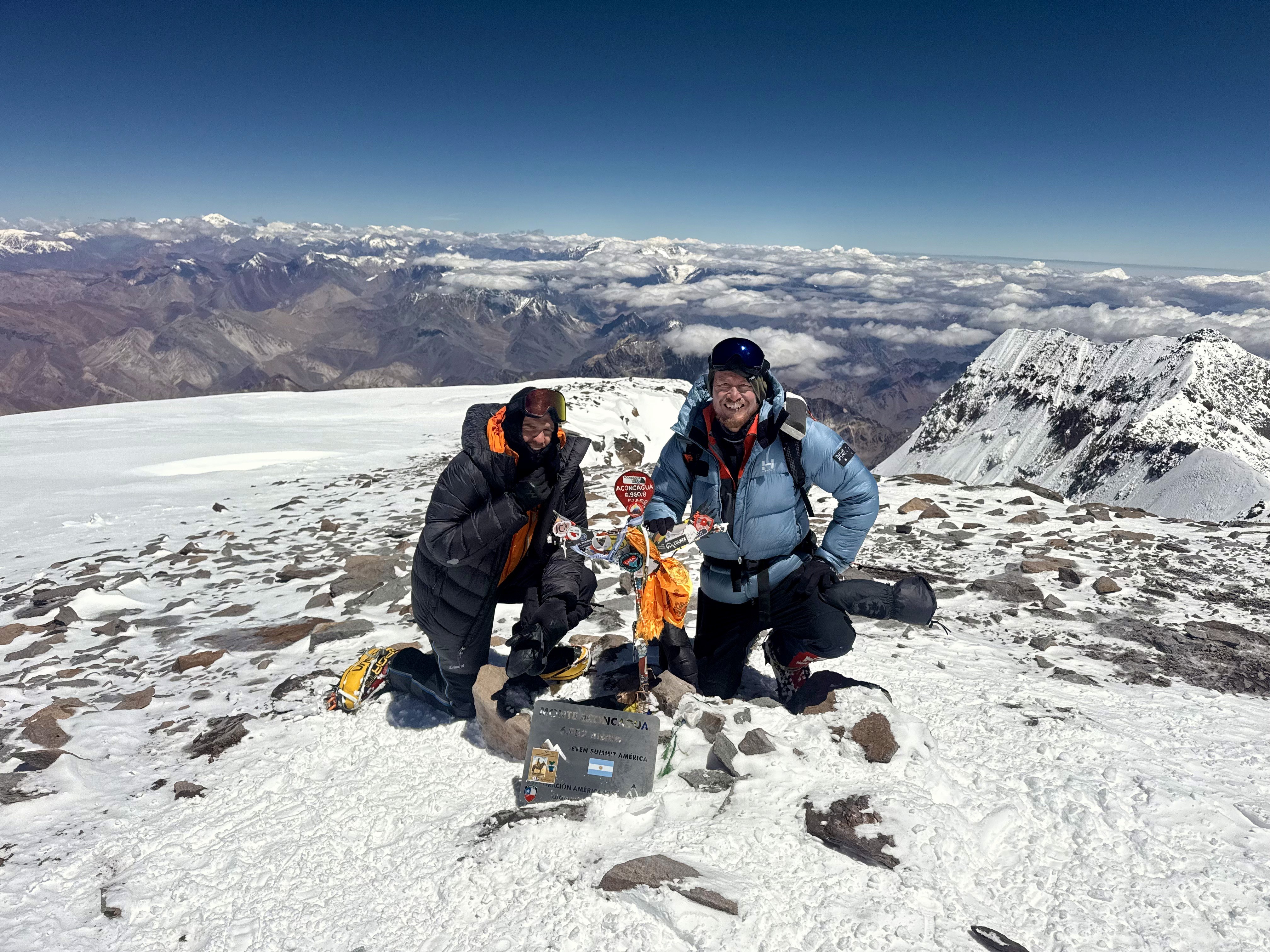
Around 2 p.m., we stepped onto the summit together.
6,961 meters.
The highest point in Argentina.
The highest mountain in South America.
And the highest mountain anywhere on Earth outside Asia.
The skies were blue, but the wind was blowing around 30 kilometres an hour and spindrift was tearing across parts of the summit.
A Russian Seven Summits arrived on the summit shortly after us. There were smiles, high-fives and congratulations all around.
For me, it was another major objective completed.
Aconcagua. Seven Summits. Done.
But we still had a very long way to go.
THE LONG WAY DOWN
We didn't spend long celebrating.
It was already around 2 p.m., we'd started late, and there was a lot of mountain underneath us.
We descended quickly and made it back to Camp Cólera somewhere around 6 p.m.
At that point, stopping would have been the sensible and comfortable option.
Instead, we packed the tent.
I wanted to get all the way back to Plaza de Mulas.
We descended through Camp Nido and continued down the mountain as darkness took over.
By the time we finally stumbled into Base Camp, it was around midnight.
I was far too tired to pitch the tent.
So I found a spot on the floor of our logistics tent, surrounded by expedition bags and equipment, threw down my sleeping bag and went to sleep.
It wasn't glamorous.
But it was comfortable enough.
WHAT'S NEXT?
A few hours later, we were awake again.
Everything hurt.
But the mountain wasn't going to walk itself out.
We left our heavier equipment for the mules, put on our daypacks and started the long 27km trek out of Aconcagua.
By mid-afternoon we'd reached the end of the trail.
From there it was paperwork, a bus back to Mendoza and eventually the Sheraton.
Hot shower.
Pizza.
Beer.
And finally, sleep.
Aconcagua was a big objective. Another Seven Summits mountain was complete, and we'd climbed it extraordinarily quickly because our weeks in the mountains beforehand had allowed us to arrive already acclimatized.
More importantly, the experiment was working.
I was getting stronger.
I was recovering faster.
Long days at altitude were becoming normal.
And with Everest getting closer, that was exactly where I wanted to be.
We spent two nights recovering in Mendoza.
Then we packed our bags again and headed for the airport.
Next stop: Bolivia.
MOUNTAIN DETAILS
ALTITUDE
6,962
M
COUNTRY / REGION
Argentina
ROUTE
Normal Route
OPERATOR / GUIDE
Self Organized
CONTINENT
South America
MOUNTAIN RANGE
Andes
https://youtu.be/YpmlRBd8vhQ
