
EXPEDITION OVERVIEW
STATUS
SUMMITED
EXPEDITION YEAR
2026
THE HIGHEST VOLCANO
Ojos del Salado had always been part of the South American plan.
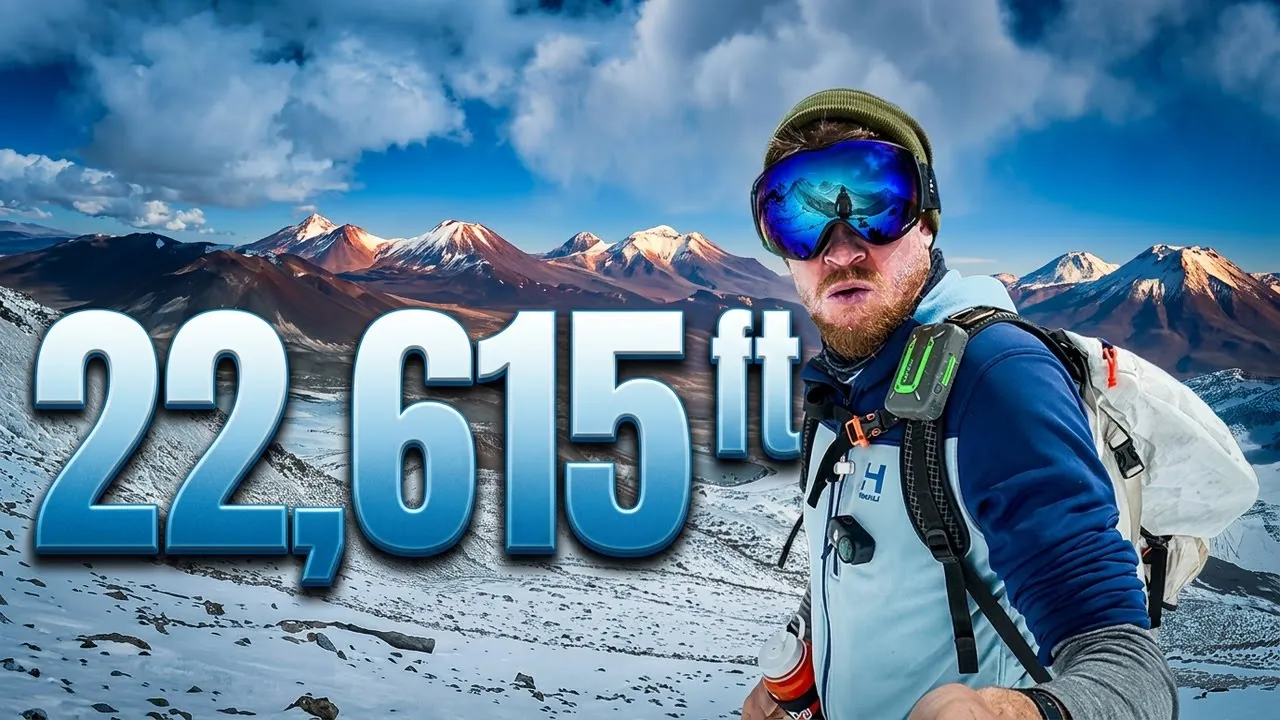
At 6,893 meters, it’s the highest volcano in the world, the highest mountain in Chile and another objective in my Seven Volcanic Summits project.
But there was another reason for climbing it.
Aconcagua was next.
Victor and I had just finished a rapid series of climbs in Ecuador, including Chimborazo and Cotopaxi on consecutive nights. We were becoming increasingly acclimatized, and Ojos gave us another opportunity to spend time close to 7,000 meters before heading to Argentina.
There was no big expedition team waiting for us in Chile.
No guide.
No established itinerary.
We flew from Quito through Lima and Santiago to Copiapó, rented an old manual Toyota Hilux and decided to figure the rest out ourselves.
The plan was simple.
Drive into the Atacama.
Climb Ojos.
Get back out.
Then get on a plane to Argentina.
INTO THE ATACAMA
The drive into Ojos was an adventure by itself.
It took most of the day.
Highway became dirt road. Dirt road became increasingly serious four-wheel-driving as we pushed deeper into the Atacama and higher into the mountains.
Victor couldn’t drive a manual, so I was behind the wheel for all of it.
Apparently you can make it well into your thirties without learning to drive a stick.
The weather changed constantly.
Sunshine. Snow. Hail.
At one point the atmosphere around us became so electrically charged that the Hilux started giving us static shocks.
There was lightning around the mountain, so getting out of the vehicle didn’t seem particularly intelligent.
We found an old chain in the back of the truck and hung it from the chassis so it dragged along the ground.
The shocks stopped.
Eventually, after roughly eight or nine hours on the road, we reached the high refuge at around 5,800 meters.
There was just one problem.
It was full.
So we climbed into the back of the Hilux, pulled out our -30°C sleeping bags and made the truck our home for the night.
Outside, temperatures dropped toward -15 or -20°C.
We set the alarm for 3 a.m.
TOO COLD
At 3 a.m., the alarm went off.
Neither of us moved.
We were warm inside our sleeping bags, it was brutally cold outside, and suddenly climbing Ojos didn’t seem quite as urgent as it had the night before.
We made the executive decision to go back to sleep.
At around 6 a.m., the sun began appearing over the horizon.
That was enough.
We crawled out of the Hilux, got our gear together and finally started climbing.
It was a ridiculously late start for a mountain approaching 7,000 meters, but the conditions were clear and we were already highly acclimatized.
The lower mountain was cold enough that I started in my heavy HIMALI Altitude Down Jacket and Mountain Hardwear Absolute Zero mitts.
There had also been considerably more snow than I’d expected.
Ojos is normally known for loose volcanic terrain, but much of our route was covered in snow. We put crampons on and slowly worked our way upward through the switchbacks.
Then the sun came out.
And everything changed.
THE CACHE
By late morning, what had started as a bitterly cold climb had become hot.
Really hot.
Layers came off one after another.
Somewhere around 6,500 meters, carrying my heavy HIMALI Altitude Down Jacket and Mountain Hardwear Absolute Zero mitts started to feel ridiculous.
So we cached them.
The logic seemed perfectly reasonable.
We’d collect everything on the way back down.
For the next couple of hours, the decision looked like a good one.
Then the mountain reminded us where we were.
Cloud started building.
The wind increased.
The temperature dropped rapidly.
By the time we reached the crater and began approaching the final summit section, the conditions were completely different.
My lighter gloves were now wet.
And the gear designed for exactly these conditions was sitting hundreds of meters below us.
At around the same time, Victor began struggling with the cold.
Eventually, he made the decision to turn around.
I kept going.
THE FINAL 70 METERS
The final section of Ojos is completely different from most of the climb.
After hours of relatively straightforward high-altitude walking, the last roughly 70 vertical meters become scrambling and climbing through loose volcanic rock.
Normally, it wouldn’t have been particularly intimidating.
With freezing, wet hands, it was a different story.
I worked my way upward through the rocks until there was nowhere higher to go.
Around 3 p.m., I stepped onto the summit.
6,893 meters.
The highest volcano on Earth.
The highest point in Chile.
And another Seven Volcanic Summits objective complete.
I was alone.
The weather was deteriorating and my hands were freezing.
There was no reason to hang around.
I took the summit photo, spent barely a minute or two at the top and immediately started descending.
Getting to the summit had been one problem.
Now I had to find my way back.
WHERE'S THE GEAR
The descent became increasingly uncomfortable.
Cloud, snow and wind moved across the mountain, and visibility deteriorated.
The route that had been obvious on the way up was suddenly much harder to follow.
Several times I found myself away from the trail and had to correct my direction.
But there was another problem.
Our gear cache was somewhere around 6,500 meters.
My HIMALI Altitude Down Jacket.
Mountain Hardwear Absolute Zero mitts.
Equipment I definitely didn’t want to abandon on Ojos.
When I reached roughly the right altitude, I couldn’t find it.
For a moment, I genuinely wondered whether we’d lost it completely.
I started searching across the slope, working back and forth around the area where I remembered leaving everything.
Eventually, there it was.
I pulled the warm gear back on and continued downward.
Rather than following every switchback, we descended more directly wherever conditions allowed, trying to lose altitude as quickly as possible.
At around 6 p.m., we finally reached the Hilux.
Roughly twelve hours after leaving it.
GET OUT
We were exhausted.
There were still no beds available at the refuge, and neither of us had much interest in spending another freezing night sleeping in the back of the Hilux at 5,800 meters.
So we did the only logical thing.
We started driving.
I drove us out of the mountains, across the Atacama and back toward Copiapó through the night.
We reached the hotel at around 3 a.m.
A few hours of sleep.
Then it was back to the airport.
Copiapó to Santiago.
Santiago toward Mendoza.
Ojos had effectively become a three-day smash-and-grab expedition: fly in, rent a truck, drive into the desert, sleep in the back, climb the highest volcano in the world, drive back out and leave Chile.
There wasn’t much time to celebrate.
Because the next mountain was already waiting.
Aconcagua.
MOUNTAIN DETAILS
ALTITUDE
6,893
M
COUNTRY / REGION
Chile / Argentina
ROUTE
NORMAL ROUTE
OPERATOR / GUIDE
CONTINENT
South America
MOUNTAIN RANGE
Andes
https://youtu.be/YpmlRBd8vhQ
