
GEAR GUIDE / 8,000M MOUNTAINEERING
My Complete 8,000m Mountaineering Kit
The clothing, climbing equipment, sleeping system, food, electronics and emergency gear I actually carry above base camp on an 8,000 metre expedition and the lessons that shaped every choice.
OUTDOOR PIRATE · 8,000M GEAR
FIELD NOTES / 8,000M KIT
There is no single perfect kit for climbing an 8,000-metre mountain.
What I carry changes with the route, season, weather, level of expedition support and whether I am climbing with supplemental oxygen. A self-supported climb on Khan Tengri requires a different setup from a commercially supported expedition on Everest.
This is not a universal packing list.
It is the system I have developed through years of expeditions, including climbs on Everest, Lhotse, Makalu, Annapurna, Manaslu and numerous 6,000- and 7,000-metre mountains.
At this altitude, weight matters, but the lightest option is useless if it cannot keep you warm, moving and able to make good decisions.
Every piece below has earned its place through use on real expeditions.
CHAPTER 1
BUILDING THE HIGH-ALTITUDE SYSTEM
The system starts before the mountain. I use The North Face and Patagonia Black Hole duffels to move expedition loads, then switch to purpose-built packs above base camp.
For heavy carries I use the Blue Ice Stache 90. The Hyperlite Mountain Gear Halka 55L covers most rotations, while the Prism 40L is my stripped-back summit pack.
At base camp, comfort supports recovery: a Sea to Summit Alpine -29 sleeping bag, Ether Light XR insulated mat and NEMO Fillo pillow.
Higher on the mountain I switch to a RAB -40 bag and a Therm-a-Rest NeoAir XTherm NXT. The sleeping bag also becomes the overnight drying room for boot liners, socks, gloves, electronics and sometimes a Nalgene.
My clothing is a layered system: Smartwool next to skin, HIMALI and Mountain Hardwear through the middle, then Arc’teryx shells and expedition down when conditions demand it.
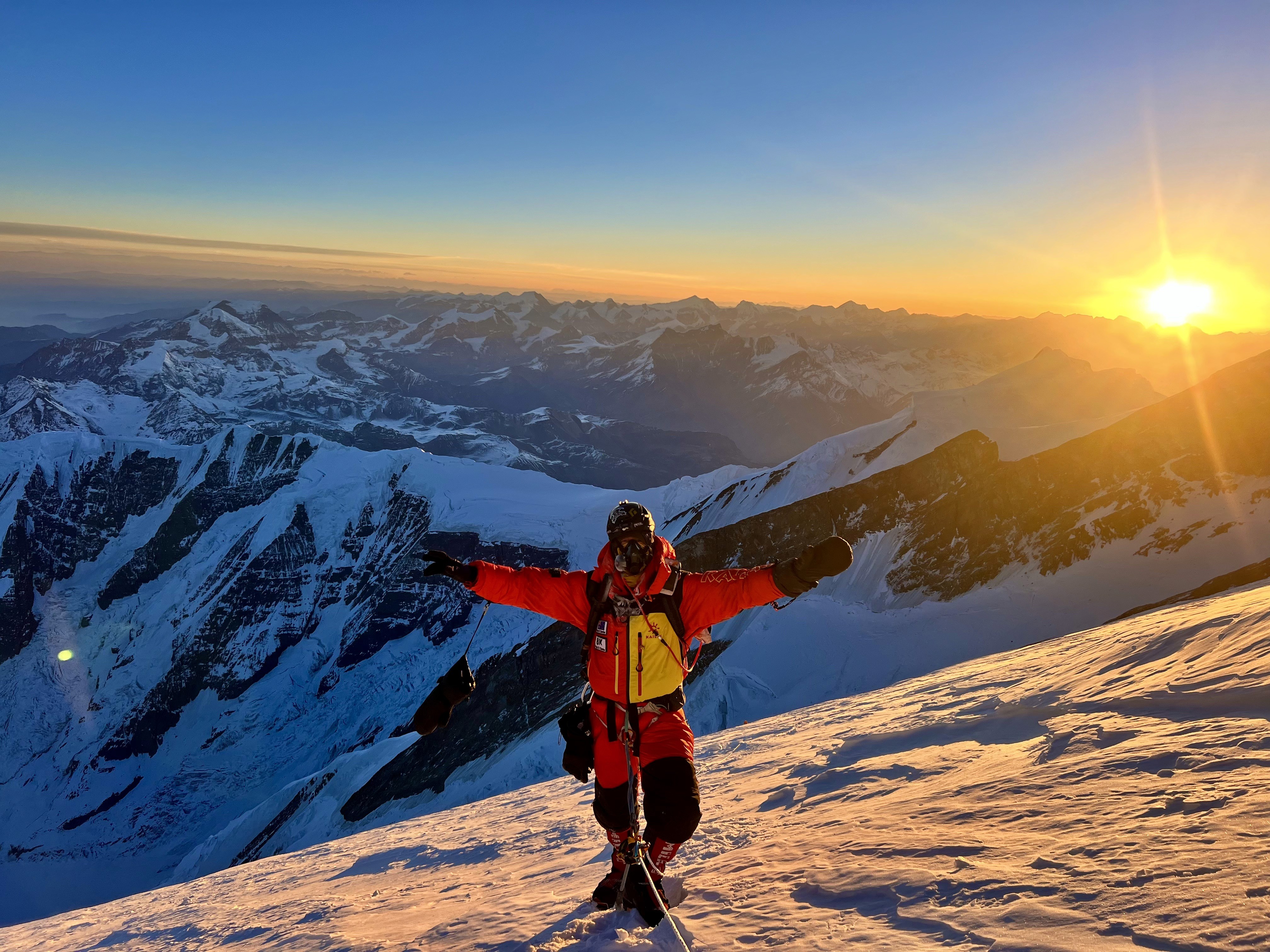
For the highest and coldest days I use either the Pioneer Camp 7000m suit or the Kailas 8000m down suit. There are no fresh changes of clothing above base camp, the system has to work continuously.
Shelter and cooking depend on the expedition. Operator tents are heavier but extremely strong; on self-supported climbs I use a light Samaya assault tent and accept the smaller living space.
THE LIGHTEST SYSTEM THAT REMAINS DEPENDABLE ENOUGH FOR THE MOUNTAIN.
-40°C
HIGH-CAMP BAG
90L
LOAD-HAULING PACK
3×
SOCK LAYERS ON SUMMIT
1L
SUMMIT FLUID
CHAPTER 1 / KEY GEAR
THE FOUNDATION OF THE KIT
Six pieces at the centre of my high-altitude system—from load carrying and sleep to shelter, heat and summit protection.
Hyperlite Mountain Gear
Hyperlite Mountain Gear Prism 40L
My smaller technical mountain pack for objectives where I want a lightweight setup without carrying the volume of a full expedition pack.
RAB
RAB -40 mountain sleeping bag
Extreme-cold sleeping bag I use for very high mountain camps when recovery and warmth are priorities.
QUANTITY CARRIED: 3
MSR
MSR Reactor
Expedition stove system I use for boiling water and preparing simple meals at camp.
QUANTITY CARRIED: 2
Samaya
Samaya Assault Ultra
Lightweight mountain shelter I use when I need a compact tent for exposed camps and fast-moving alpine objectives.
Kailas
Kailas 8000m Down Suit
My full down suit for 8,000m expeditions, built around staying protected during extremely cold high-altitude summit pushes.
Sea to Summit
Sea to Summit Ether Light XR Insulated Air Sleeping Pad
Insulated sleeping mat that forms the foundation of my sleep system for mountain camps and expedition base camps.
These products are part of a wider system. The right choice always depends on the route, forecast, support and how much weight the team can realistically move.
SLEEP BECOMES PART OF THE SYSTEM
Sleep is recovery, but high on an 8,000er the sleeping system has another job: keeping critical equipment warm and dry.
At base camp I prioritise comfort with the Sea to Summit Alpine -29 bag, Ether Light XR insulated pad and NEMO Fillo pillow.
Above base camp I use the warmer RAB -40 bag with a Therm-a-Rest NeoAir XTherm NXT. Both are packed into Sea to Summit compression sacks for carries.
Boot liners, socks, glove liners, camera batteries, power banks, the phone and the inReach all come into the bag overnight.
It gets crowded, but body heat protects battery life and stops damp kit from freezing solid before the next carry.
A sleeping bag at high camp is not just bedding. It is part of the expedition’s equipment-management system.

THE CLOTHING I LEAVE BASE CAMP IN IS THE CLOTHING I SUMMIT IN
I start with Smartwool base layers, liners and socks, then add HIMALI fleece and pants or Mountain Hardwear softshell layers according to the temperature and work rate.
Arc’teryx Alpha shells and Pioneer shell pants handle wind and weather. Mountain Hardwear down pants and the HIMALI Altitude Down Jacket add warmth around camp.
For the summit and the coldest high camps I move into a Pioneer Camp 7000m suit or Kailas 8000m down suit.
I do not carry spare outfits. Extra clothing quickly becomes dead weight, so every layer has to work with every other layer.
The aim is not to own the most clothing. It is to build one adaptable system that manages sweat, wind and extreme cold without unnecessary duplication.

TENTS, COOKING AND MELTING SNOW
On supported expeditions the operator normally supplies proper high-mountain tents. They can weigh around four kilograms, but they are reassuringly strong in serious wind.
On self-supported climbs such as Khan Tengri, we carried a two-person Samaya assault tent weighing roughly 800 grams. It is fast and light, but tight inside and lacks a useful vestibule.
The MSR Reactor is the stove I trust. We use the smaller pot for two people and the larger version for a bigger team, melting dense snow or ice whenever possible because it produces more water for the fuel used.
Cooking happens in a ventilated vestibule whenever possible. A YETI mug, TOAKS long-handled spork, Petzl knife and redundant boxes of matches complete the setup.
A RELIABLE STOVE SAVES FUEL, WEIGHT AND TIME ON EVERY ROTATION.
WHAT I WEAR, EAT AND CLIMB WITH
My main technical setup is Petzl Sarken crampons, a Sum’Tec ice axe, Blue Ice Choucas Pro harness, Black Diamond Vapor helmet and Petzl Actik Core headlamp.
For glacier travel I carry a Micro Traxion, Tibloc, eight metres of cordelette and several carabiners. A shovel normally stays with the team up to Camp Three for tent platforms and digging out camp.
Trekking poles are Black Diamond Alpine Carbon Corks. They take years of abuse and give reliable support during long carries and descents.
The goal is a compact system with enough redundancy to solve real problems, not a rack full of equipment that never leaves the pack.
Technical equipment, hands, feet and eyesight are not areas where I compromise simply to save a few grams.
Petzl
Petzl Sarken Crampons
Technical mountaineering crampons I use for high-altitude climbing across snow, ice and more technical mountain terrain.
Petzl
Petzl Sum'Tec Ice Axe
Versatile technical ice axe I use on high-altitude expeditions where routes can vary from straightforward snow to steeper terrain.
QUANTITY CARRIED: 1-2
Blue Ice
Blue Ice Choucas Pro Harness
Lightweight mountaineering harness I use for high-altitude expeditions, glacier travel and technical climbing in the mountains.
La Sportiva
La Sportiva Olympus Mons Pro
High-altitude mountaineering boots I use for cold 8,000m objectives and long summit days.
Lenz
Lenz Heated Socks
Heated socks I use when I want an additional option for keeping my feet comfortable in very cold conditions.
Julbo
Julbo Lightyear OTG goggles
OTG mountain goggles I use on snowy, windy days when sunglasses are not enough.
HANDS, FEET AND EYES ARE NOT WHERE I GAMBLE TO SAVE A FEW GRAMS.
KEEPING MY HANDS WORKING
At lower camps I use Hestra Windstoppers. Higher up, Icebreaker liners sit inside the Hestras, then inside Mountain Hardwear technical gloves or summit mitts depending on the terrain and cold.
I carry spare liners and mid-layer gloves. Wet pairs go inside the summit suit while moving or into the sleeping bag overnight to dry.
For carabiners or detailed rope work the mitts have to come off. For straightforward jumaring I can often keep them on and operate the handle with my thumb through the grip.
Frostnip on Peak Lenin and losing a Hestra glove on Khan Tengri reinforced the lesson: protect the system, tether what you can and always retain a workable backup.
BOOTS, SOCKS AND CIRCULATION
My main boots are the La Sportiva G-Tech and Olympus Mons Pro. The G2 Evo is still excellent, but the other two overlap its range and reduce the number of bulky boots I need to travel with.
Around 6,500 metres and above I normally choose the Olympus Mons Pro unless the mountain is unusually warm. Below roughly 6,000 metres I generally use the G-Tech.
The sock system starts with thin Smartwool liners to reduce friction, followed by Smartwool summit socks.
On summit night I add Lenz heated socks. I run the heat only when needed, often in short timed bursts, to protect both circulation and battery life.
I save one completely brand new pair of summit socks for summit push because insulation flattens with use and loses warmth.
Boot liners, liners and socks all come into the sleeping bag overnight. Keeping them warm and dry matters more than having a tidy tent.
Blisters should be taped at the first sign of trouble. I rarely suffer them now, but liner socks and early action make a major difference.
The most common boot mistake is sizing too small. Three sock layers need space, and compressed feet lose the circulation that keeps toes warm.

HEAD / FACE / WATER / FOOD
THE SMALL SYSTEMS THAT KEEP ME MOVING
A BUFF stays around my neck from base camp to summit, usually pulled over my ears and nose. In harsher wind I switch to a Mountain Hardwear balaclava, with a Mons Royale merino beanie or trucker cap on top.
Julbo Shield sunglasses are my everyday eye protection. Julbo Lightyear OTG goggles come out for summit push, strong wind and blowing snow. Together they provide redundancy if either pair fails.
An OuterU nose guard, SPF 50 lip balm and a modified BUFF that works around the oxygen mask protect the exposed strips of skin that are easiest to miss.
I normally carry about one litre: electrolytes in a Nalgene lower down, then tea in a Thermos Light 1L when bottles begin to freeze. Hydration bladders and exposed tubes are not dependable at altitude.
Food is simple and easy to eat: instant noodles enriched with butter or olive oil, soup, instant oats, bars, biscuits, chocolate, gummy sweets and energy gels.
On summit night I take only a couple of bars and gels. Coffee and caffeinated gels help, but I use them deliberately rather than continuously.
We budget roughly one kilogram of food per person per day. Frozen apples and heavy drinks such as Coca-Cola are reminders that what feels attractive at base camp is not always worth carrying higher.
BUFF
BUFF
Versatile neckwear I use as a light layer for sun, wind, warmth and general mountain comfort.
CHAPTER 3
SUMMIT PUSH AND EMERGENCY SYSTEMS
Garmin
Garmin fēnix 8
The GPS watch I use for training, trekking and expeditions to track my movement, altitude and activity in the mountains.
Garmin
Garmin inReach Messenger Plus
Satellite communicator I carry as part of my communications and safety setup beyond reliable mobile coverage.
Petzl
Petzl Actik Core
My main on-mountain headlamp for alpine starts, overnight summit pushes and moving through the mountains in darkness.
Nitecore
Nitecore NU20
Small lightweight headlamp I use around camp so I don't need to use my primary climbing headlamp for everyday tasks.
FlexSolar
FlexSolar 36W Portable Solar Panel
Lightweight solar panel I carry higher on the mountain when I need independent power away from Base Camp.
FIELD LESSONS
EVERY GRAM NEEDS A REASON
Electronics are unusually important in my kit because I am also filming. I carry cameras, two 10,000mAh power banks, a Garmin fēnix 8 and an inReach. The Petzl Actik Core is my summit headlamp, with a Nitecore NU20 as backup. Batteries and devices live in a Sea to Summit pouch, then inside the sleeping bag or summit suit when the cold becomes severe.
My oxygen equipment is the standard operator-supplied high-mountain mask, regulator and four-litre carbon-fibre cylinders. The altitude where I start depends on acclimatization, pace and supply. I usually carry two cylinders and calculate flow against the hours ahead. Frozen valves are a genuine danger, so the system is checked continuously, there is no universal formula for oxygen use.
The personal first-aid kit is deliberately small: plasters, Imodium, paracetamol and ibuprofen, backed by the shared team kit. Repairs rely on duct, electrical and sports tape, two cable ties, adhesive patches, a short length of 1mm Spectra cord and a lightweight Petzl knife. That simple cord once secured a failed crampon strap on Aconcagua.
Inexperienced climbers often overpack food, liquid calories, clothing, toiletries, hand warmers, first aid and duplicate tools. I will save weight there, but not on the sleeping bag, down suit, crampons, eyewear, headlamp or technical climbing equipment. The smallest item I would notice immediately if I forgot it is my BUFF.
AFFILIATE DISCLOSURE
Some links in this guide are affiliate links. If you purchase something through one of these links, I may earn a commission at no additional cost to you. I only feature equipment I genuinely use or recommend, and affiliate relationships don’t determine what makes it into my kit.
As an Amazon Associate I earn from qualifying purchases.
