EXPEDITION OVERVIEW
STATUS
SUMMITED
EXPEDITION YEAR
2025
HOW IT STARTED
Manaslu wasn’t the beginning of some carefully planned mission to climb all fourteen 8,000-metre peaks.
At the time, I just wanted to know what climbing above 8,000 metres was actually like.
I’d spent the summer in Europe climbing Mont Blanc, Gran Paradiso, the Dom and other peaks in the Alps before travelling to Central Asia and climbing Lenin Peak.
Lenin was my first 7,000-metre mountain and my first real experience of a longer expedition at altitude.
The obvious question was: what comes next?
My Australian friend Abhishek, Abi, was planning to climb Manaslu that September and kept pushing me to come. I’d also met climbers in Chamonix who encouraged me to make the jump to 8,000 metres.
Eventually, I decided to do it.
Then, while descending Lenin, Abby fell into a crevasse and badly injured his knee, tearing his ACL and MCL.
His Manaslu expedition was over before it started.
Mine wasn’t.
I flew to Nepal alone, still not entirely sure what I’d signed myself up for.
I wasn’t trying to start a fourteen-peak project.
I was going to Manaslu to find out whether I belonged on the world’s highest mountains.
INTO MANASLU
I arrived in Kathmandu around August 27.
This was my first expedition with 8K Expeditions and my first time stepping into the world of commercial 8,000-meter climbing.
There were a couple of days in Kathmandu buying last-minute gear, meeting the team and going through the usual expedition preparations before we left for the mountains.
I’d already met Lakpa Sen in Central Asia while climbing Lenin. He was working there as a guide and had become a good friend, and he helped organize things for me in Nepal.
For Manaslu, I was paired with Karma Sherpa.
Karma was incredibly strong, spoke very little English and seemed determined to carry as much of my equipment as I would allow him to.
I wasn’t particularly interested in letting him.
In early September we left Kathmandu and began the journey toward Manaslu.
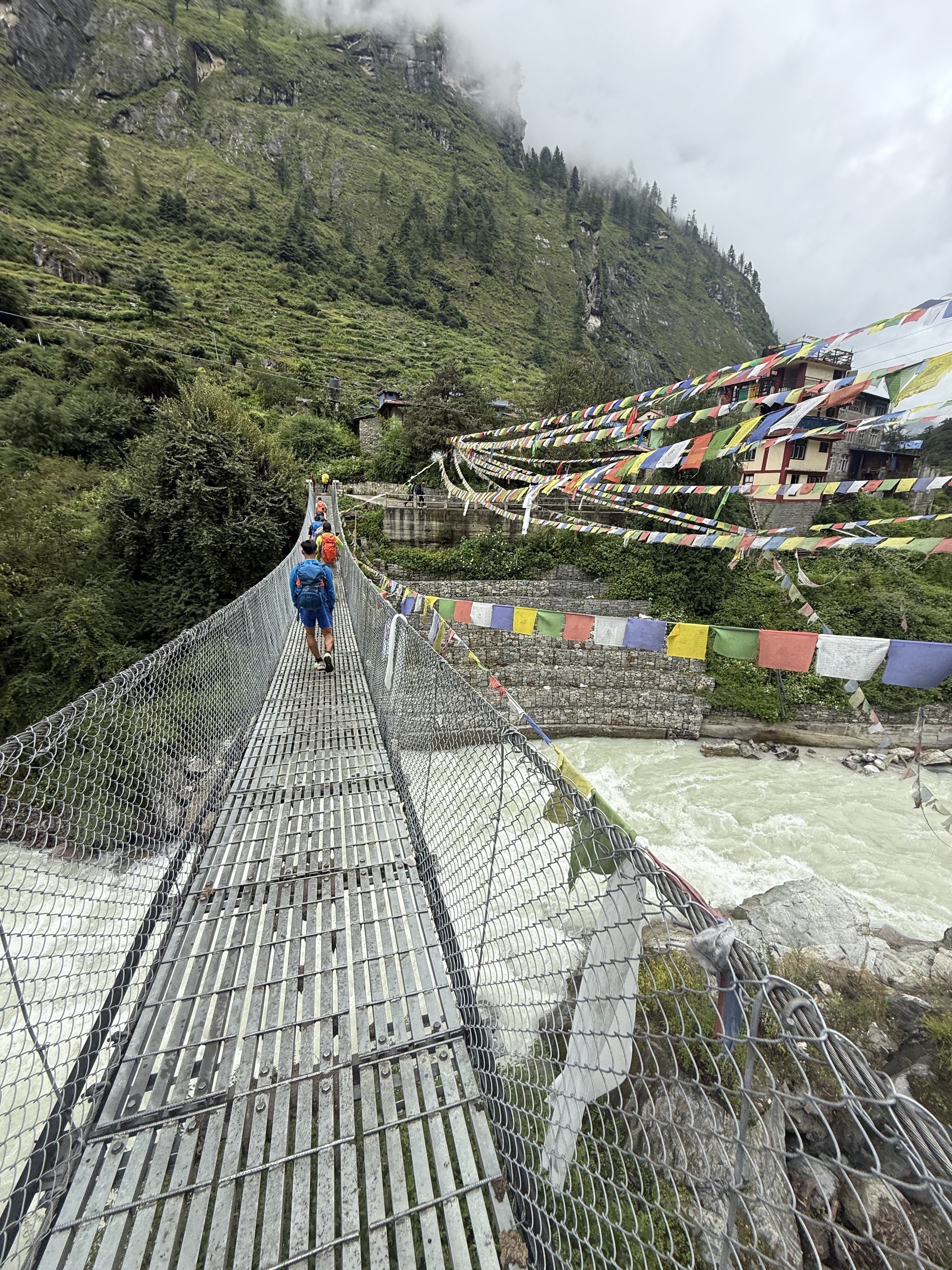
Rather than flying directly to Base Camp, we trekked through the Manaslu region for several days and crossed the Larkya Pass at around 5,100 meters.
I’ve always liked trekking into the first mountain of an expedition. It gives your body time to adjust, but it also gives you a sense of where you actually are.
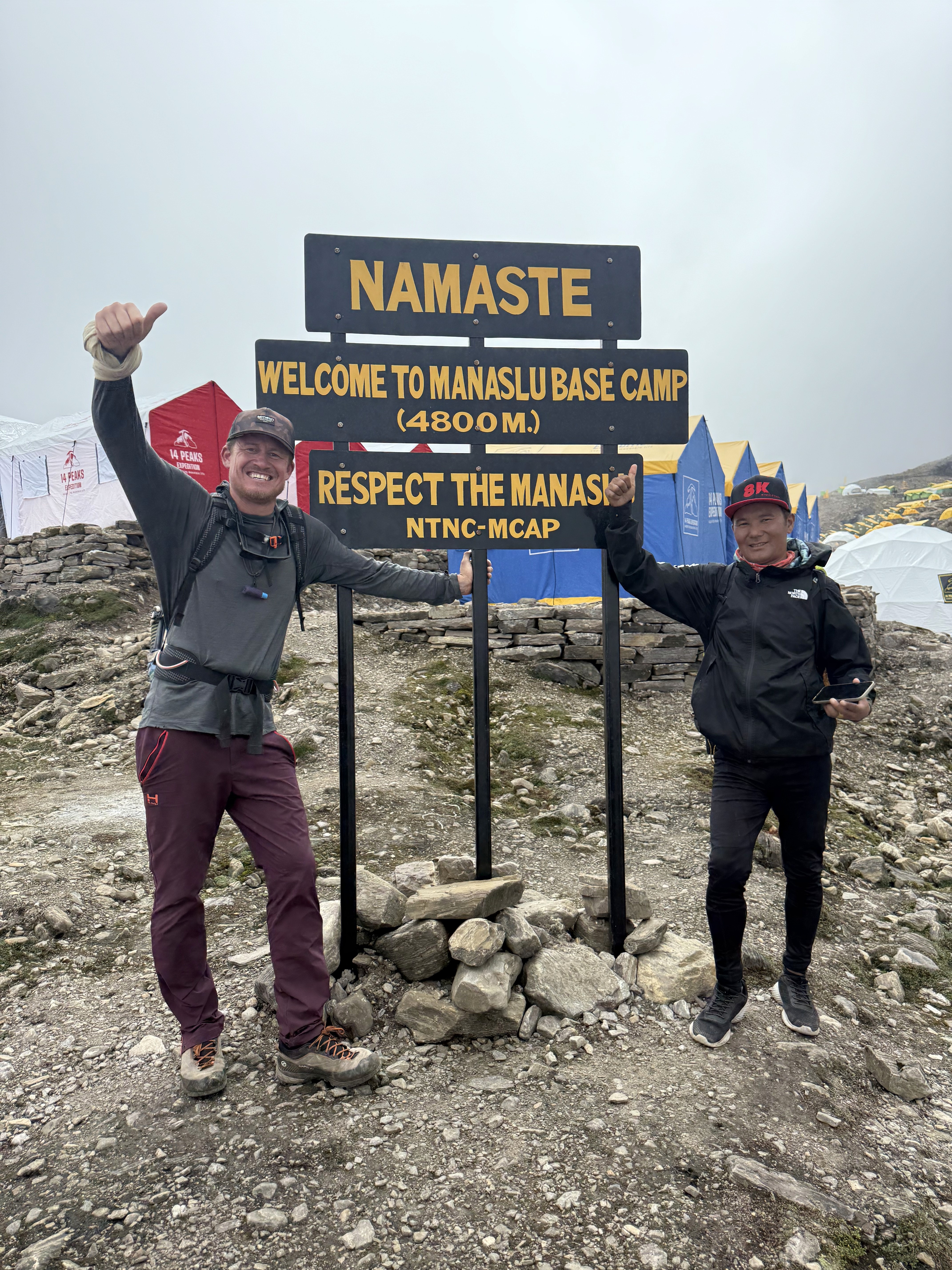
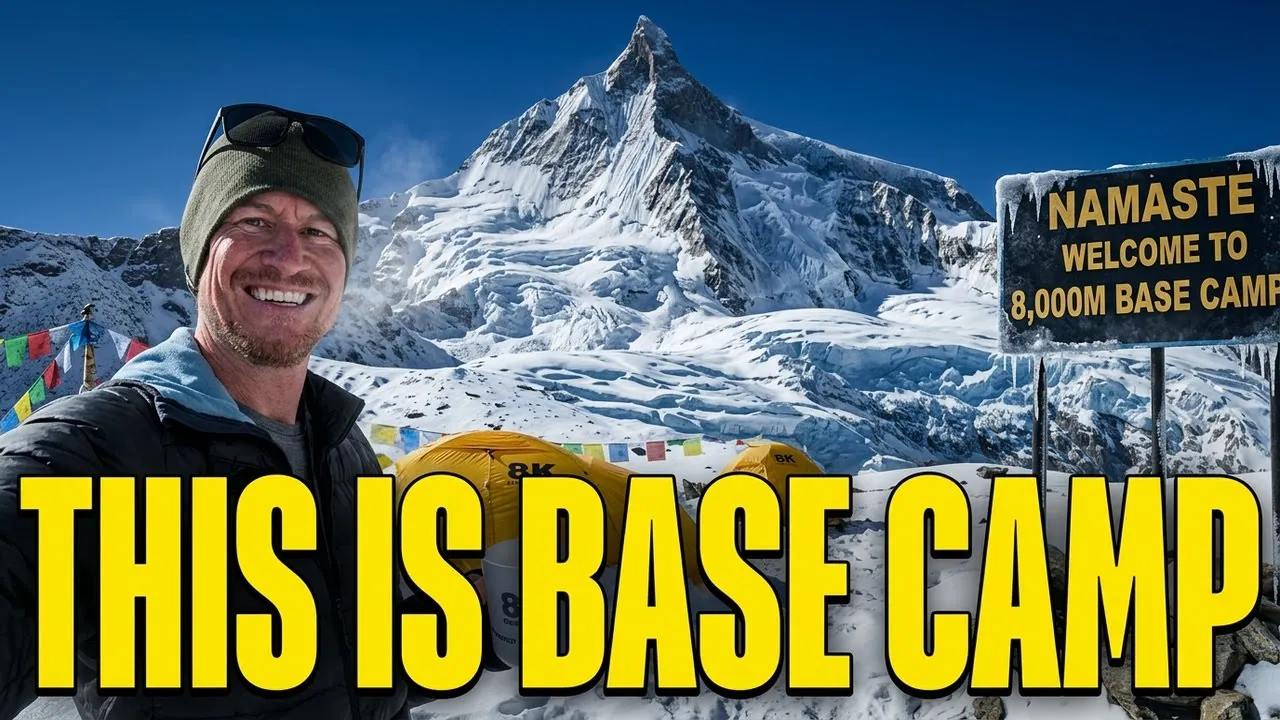
Manaslu Base Camp sits just below 5,000 meters and felt like a small city built on the side of the mountain.
Most of the time Manaslu itself was hidden in cloud.
Every now and then the clouds would open and reveal the mountain above us.
More than 3,000 vertical meters separated Base Camp from the summit.
It looked enormous.

LEARNING 8,000 METERS
Everything about Manaslu was new.
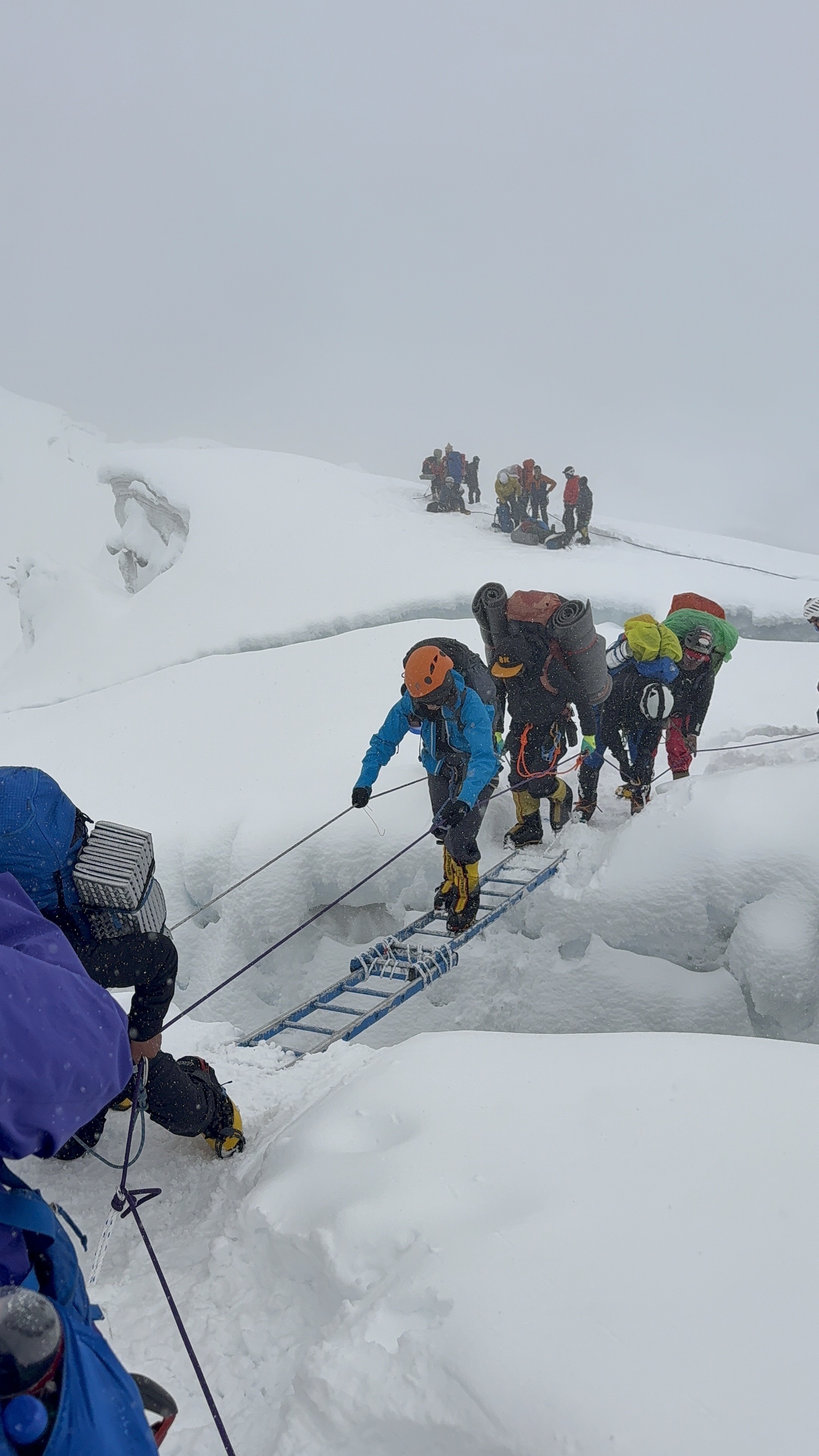
The rotations. The camps. The fixed lines. Living at Base Camp for weeks. Managing equipment and food higher on the mountain. Working with a Sherpa. Planning around weather windows.
I was learning how an 8,000-meter expedition actually worked while I was doing one.
Our first trip above Base Camp was relatively short, climbing toward Camp 1 and into the mid-5,000-meter range.
The next rotation was more serious.
We climbed from Base Camp to Camp 1, slept there and continued to Camp 2 the following day.
The plan had been to continue higher toward Camp 3.
The weather had other ideas.
Heavy snow, wind and whiteout conditions moved across the mountain and we abandoned the attempt to go higher.
We descended to Base Camp.
Then we waited.
For several days the weather remained bad while the mountain disappeared back into cloud.
There wasn’t one dramatic moment on Manaslu where everything went wrong.
It was more about learning patience, understanding the systems and discovering how my body responded as we moved higher.
Eventually the forecast began to improve.
And for the first time in my life, I was preparing to try to climb above 8,000 meters.


THE SUMMIT PUSH
After the weather window finally arrived, we moved back onto the mountain. This time there would be no coming back down until we’d either stood on the summit or the mountain told us otherwise.
Conditions on Manaslu had been surprisingly good. In fact, the weather was mild enough that I’d climbed all the way to Camp 3 in my lighter G-Tech boots before finally switching into my Millet 8,000-meter boots for the upper mountain.
Those Millets got me to the summit of my first 8,000er, but they wouldn’t remain my high-altitude boots forever. After Annapurna the following spring, I switched to the La Sportiva Olympus Mons Pro, mainly for their more modern design and significantly lighter build. They’ve since become my 8,000-meter boot of choice.
For the climb I was carrying my Hyperlite Prism 40. It was small and light, but big enough for what I needed moving between the camps. My technical setup was equally familiar: Petzl Sarken crampons, a Blue Ice harness, Petzl ascender for the fixed lines and my Petzl Sum’Tec ice axe.
Manaslu was also the first mountain where I climbed in my Kailas 8,000-meter summit suit. Once we were moving onto the upper mountain, that became the centre of my clothing system. For my hands I had Mountain Hardwear technical gloves, Hestra Windstopper gloves and liners underneath, with my Mountain Hardwear Absolute Zero mitts ready for the serious cold.
At the higher camps I was sleeping in my Rab -40 sleeping bag. Sleep at altitude is never particularly good, but having a proper high-altitude bag makes those hours lying in a tent considerably more manageable.
When it was finally time to leave for the summit, we started in darkness. My Petzl Actik Core was my main climbing headlamp, while the much smaller Nitecore was something I generally kept for using inside the tent and moving around camp at night.
Hydration was simple. I carried a one-litre Nalgene and my Thermos Light 1L, which I’d filled with hot black tea. The Nalgene froze fairly quickly during the summit push, so the Thermos ended up becoming pretty much my only reliable source of fluid high on the mountain.
Then there was nothing left to prepare.
Headlamp on. Crampons on. Clip into the fixed line.
And start climbing toward the summit of my first 8,000-meter mountain.


8,163 METERS
By around 4:30am, we were somewhere near 8,110 meters.
We were ahead of schedule.
I didn’t want my first 8,000-meter summit to happen in darkness.
So we stopped.
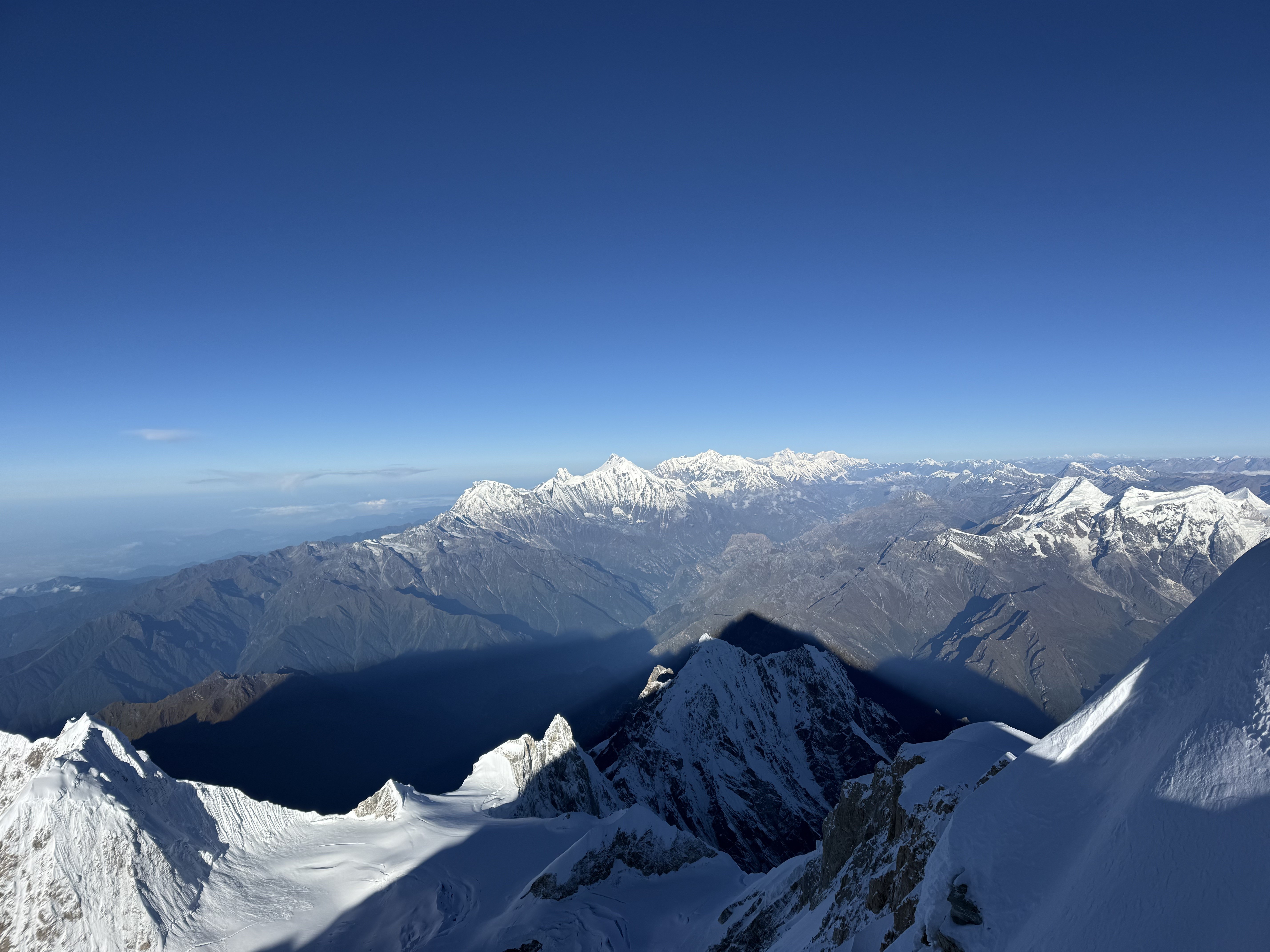
For roughly an hour we waited high on Manaslu, changed oxygen and watched the first light begin to appear across the Himalayas.
As the sun rose, the mountain cast an enormous shadow across the landscape below us.
It remains one of my clearest memories from the expedition.
I filmed the climb with my DJI Osmo Action 5 Pro and Insta360 X5. I didn’t have a drone on this expedition, the footage came from the cameras I carried up the mountain.
Then we started moving again.
Manaslu has a history of climbers stopping at fore-summits rather than reaching the true highest point, so there was never any question about where I wanted to go.
The final section involved a traverse and short climb toward the true summit.
By then a bottleneck was beginning to form along the summit ridge.
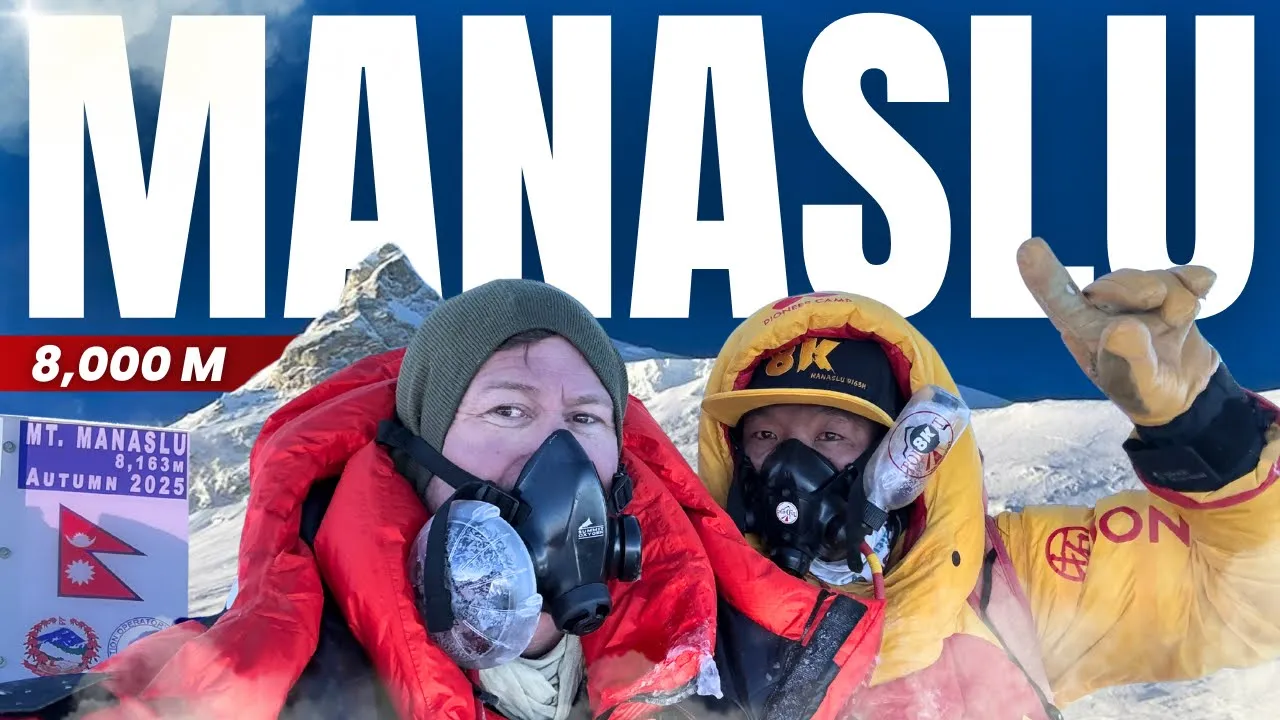
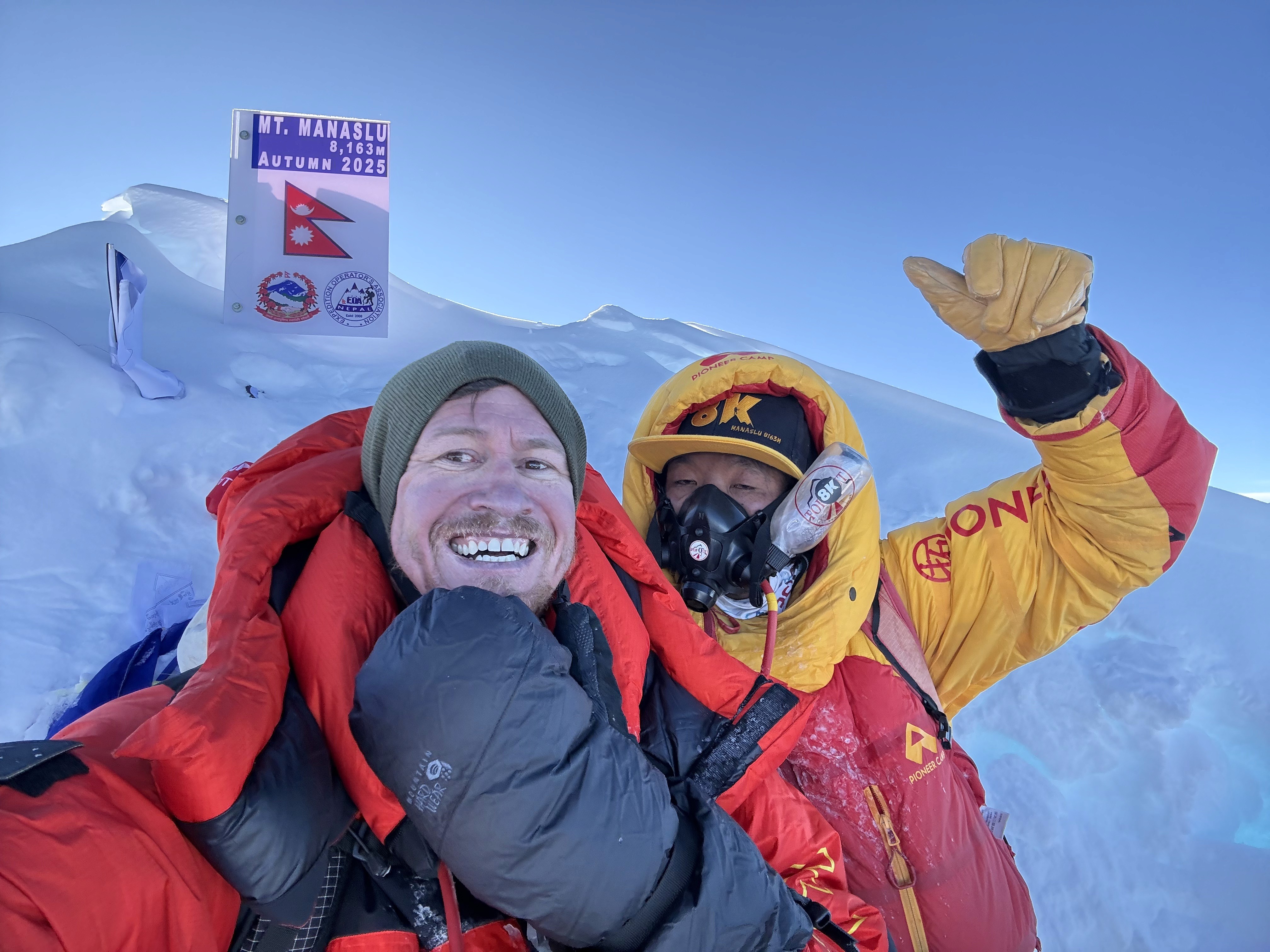
At around 6:30am on September 24, Karma and I reached the top.
8,163 meters.
My first 8,000-meter summit.
The sky was clear and there was very little wind.
Xenia reached the summit roughly an hour later, with Victor following later.
At the time, it felt like a major achievement.
But it was also strangely businesslike.
I hadn’t arrived on Manaslu with some enormous long-term plan.
I’d come to see whether I could climb an 8,000-meter mountain.
Now I had my answer.
THE LONG WAY DOWN
Reaching the summit created another problem.
Everyone else wanted to reach it too.
Below us, the summit ridge was filling with climbers.
At one point there were more than fifty people waiting below the final section, with some reportedly standing there for three or four hours.
Karma and I had to descend carefully through the ascending traffic, constantly clipping and unclipping around people on the fixed lines.
Once we were clear of the ridge, the descent became faster.
It also became hot.
Somewhere above Camp 4, I ran out of water.
Eventually I was thirsty enough that I started asking other climbers if they had anything they could spare.
We continued down through Camp 4 toward Camp 3.
The terrain was steep and the descent required constant concentration on the fixed lines.
At Camp 3 we finally stopped properly, cooked, ate and drank, and tried to recover.
By around 2 or 3pm, we were moving again.
Camp 2.
Camp 1.
Then all the way back to Base Camp.
We arrived at around 7pm.
We'd been moving for somewhere around 26 to 28 hours.
There was a summit cake waiting.
And beer.
Somehow, a handful of us from the 8K team still managed to sit around celebrating until about 9pm.
Then I went to bed.


DEFINING
Manaslu changed the direction of my climbing.
I arrived wanting to find out what an 8,000-meter expedition was really like.
I left knowing I wanted to do more.
It taught me how these expeditions worked — rotations, weather windows, fixed lines, high camps, supplemental oxygen, recovery and the patience required to spend weeks waiting for a few hours when everything finally lines up.
It also taught me something about myself.
I could function above 8,000 meters.
I could handle a long summit push.
And rather than coming away thinking I’d experienced enough of the world’s highest mountains, I wanted to understand them better.
Manaslu also gave me something I couldn’t have planned.
I met Xenia and Victor on that expedition.
I first met Xenia in the hotel lobby in Kathmandu. I met Victor during the trek into the mountain.
We shared tents, helped each other with equipment and gradually became friends.
None of us knew then how many mountains and adventures would follow.
The idea of climbing all fourteen 8,000-meter peaks developed later.
There was no master plan when I stood on the summit of Manaslu.
But looking back now, it’s easy to see the significance of that mountain.
I didn’t stand on Manaslu’s summit thinking I’d just begun a mission to climb all fourteen 8,000ers.
That came later.
But looking back, this was where a lot of it began.
Manaslu was defining.


WATCH THE STORY
EXPEDITION FILMS
MANASLU BASE CAMP TOUR
FIELD NOTES / PHOTOGRAPHS
FROM THE EXPEDITION

Kathmandu
The International Team
This was the first time we all met as a team at a cultural dinner hosted by 8K. Little did we know at this time many of us would become life long friends.

Gandaki
A Giant Chicken
Two chickens in Gandaki. (Xenia is the one in pink)

Manaslu Conservation Area
Alpine Lakes
Taken just as we were coning down from Larke Pass we passed this beautiful alpine lake. Even in the rain it was still incredibly blue.

Manaslu
Clowns
HaHa sometimes you just got to have some fun on the mountain... 🤦♂️

Manaslu Base Camp
Manaslu Puja Ceremony
The day before we began our climb a Puja ceremony was held to bless all the climbers and ask Manaslu permission to climb her.

Manaslu Camp One
Sunset at Camp One
On the summit push we had already curled up in our sleeping bags when one of the other team members said we need to get out of our tents and see the sunset. It did not dissapoint even if it was freezing cold.
MOUNTAIN DETAILS
ALTITUDE
8,163
M
COUNTRY / REGION
Nepal
ROUTE
Normal Route
OPERATOR / GUIDE
8K Expeditions
CONTINENT
Asia
MOUNTAIN RANGE
Himalaya
https://youtu.be/YpmlRBd8vhQ
