EXPEDITION OVERVIEW
STATUS
SUMMITED
EXPEDITION YEAR
2025
THE ROOF OF AFRICA
Kilimanjaro wasn’t originally a complicated expedition plan.
My good friend Monica was already heading to Tanzania to climb it and put out a message asking if anyone wanted to join her. Kilimanjaro was part of both my Seven Summits and Seven Volcanic Summits objectives, the timing worked perfectly, so my answer was pretty simple.
Why not?
I’d just finished climbing and trekking in Australia, and before heading to Europe for a summer in the Alps, I had a window to squeeze in one more mountain.
We chose the seven-day Lemosho Route, trekking from the forests on the lower slopes of Kilimanjaro through completely different landscapes before eventually reaching the high camps above the clouds.
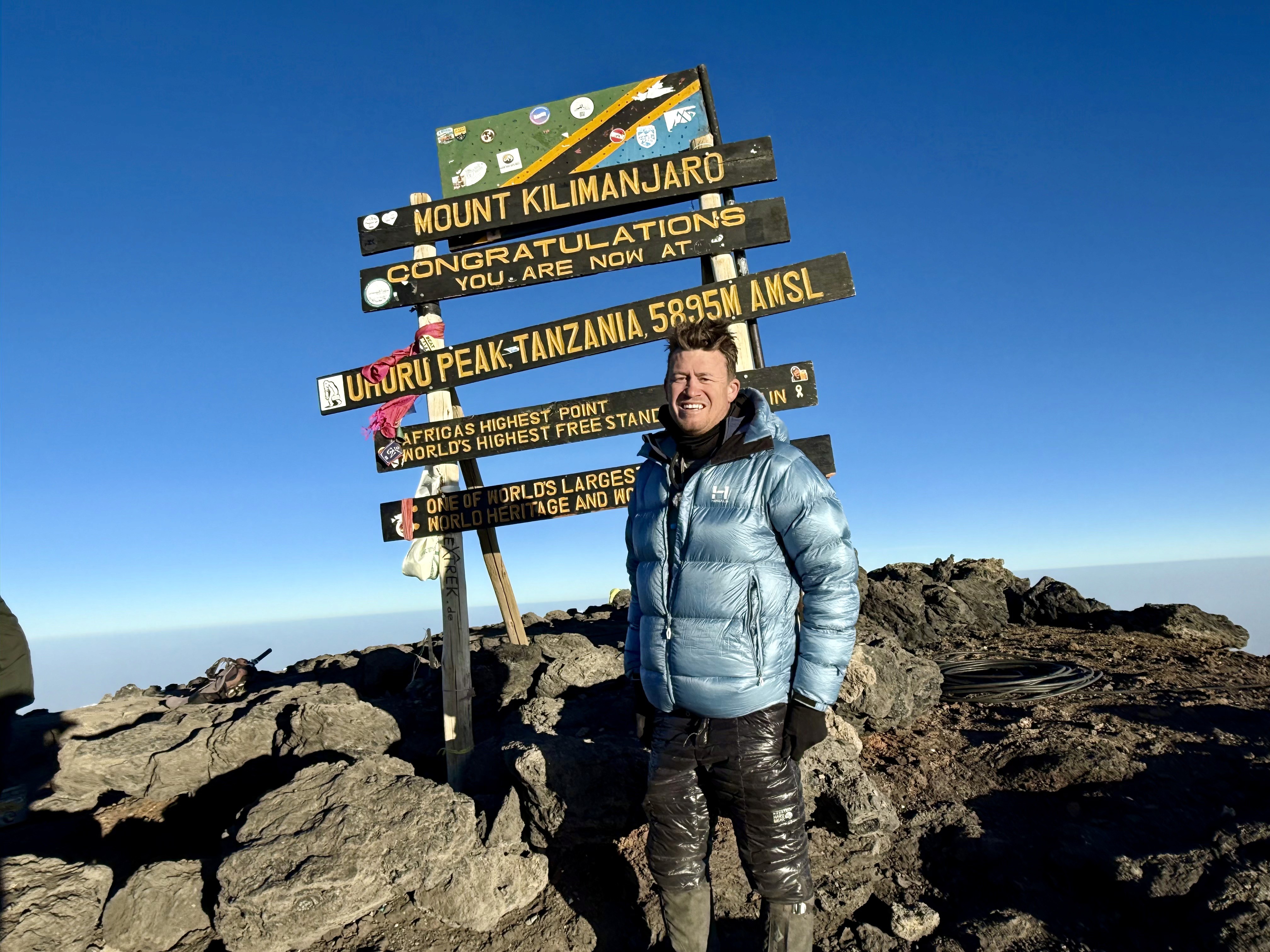
On the morning of July 4, 2025, Monica and I reached Uhuru Peak at 5,895 meters, the highest point in Africa.
I had expected Kilimanjaro to be relatively straightforward.
Summit night reminded me that altitude doesn’t always care what you expect.
WHY NOT?
Sometimes mountains begin with months of planning.
Kilimanjaro started with a message.
My good friend Monica was already planning to climb it and asked if anyone wanted to come along.
Kilimanjaro was on my list as part of the Seven Summits and Seven Volcanic Summits, and the timing couldn't have worked much better.
I'd been climbing and trekking in Australia and was about to head to Europe, where I planned to spend the summer around Chamonix climbing Mont Blanc and exploring the Alps.
There was just enough time in between for Tanzania.
So I said yes.
It was Monica's first time in Africa, and before heading to Kilimanjaro she wanted to see as much of the country, and as many animals, as possible.
So a few days before the climb, we headed out to the Serengeti for a three-night safari.
It was a pretty good way to start the trip: a few days driving around the Serengeti looking for wildlife before swapping the safari vehicle for trekking boots and heading toward the highest mountain in Africa.
A few days later, Monica and I were at the bottom of Kilimanjaro preparing to spend seven days trekking the Lemosho Route toward the summit.
THE LEMOSHO ROUTE
One of the things I hadn't fully appreciated about Kilimanjaro was just how good the trek itself would be.
The Lemosho Route takes you through an incredible variety of terrain, beginning in the green forests lower on the mountain and gradually moving into a completely different world as you gain altitude.
Because we had porters carrying the main expedition loads, I only needed a day pack. I used my Hyperlite Prism 40L, carrying the things I wanted access to during the day while the rest of my equipment travelled ahead with the crew.
But what I remember most wasn't the equipment or even necessarily the mountain.
It was the people.
The Tanzanian guides and porters were some of the friendliest and happiest people I've met anywhere in the world.
There was constantly singing, dancing and someone trying to get the rest of us involved.
It made the entire trek fun.
This wasn't just seven days trying to reach a summit.
The journey up the mountain was becoming one of the best parts of the experience.


ABOVE THE CLOUDS
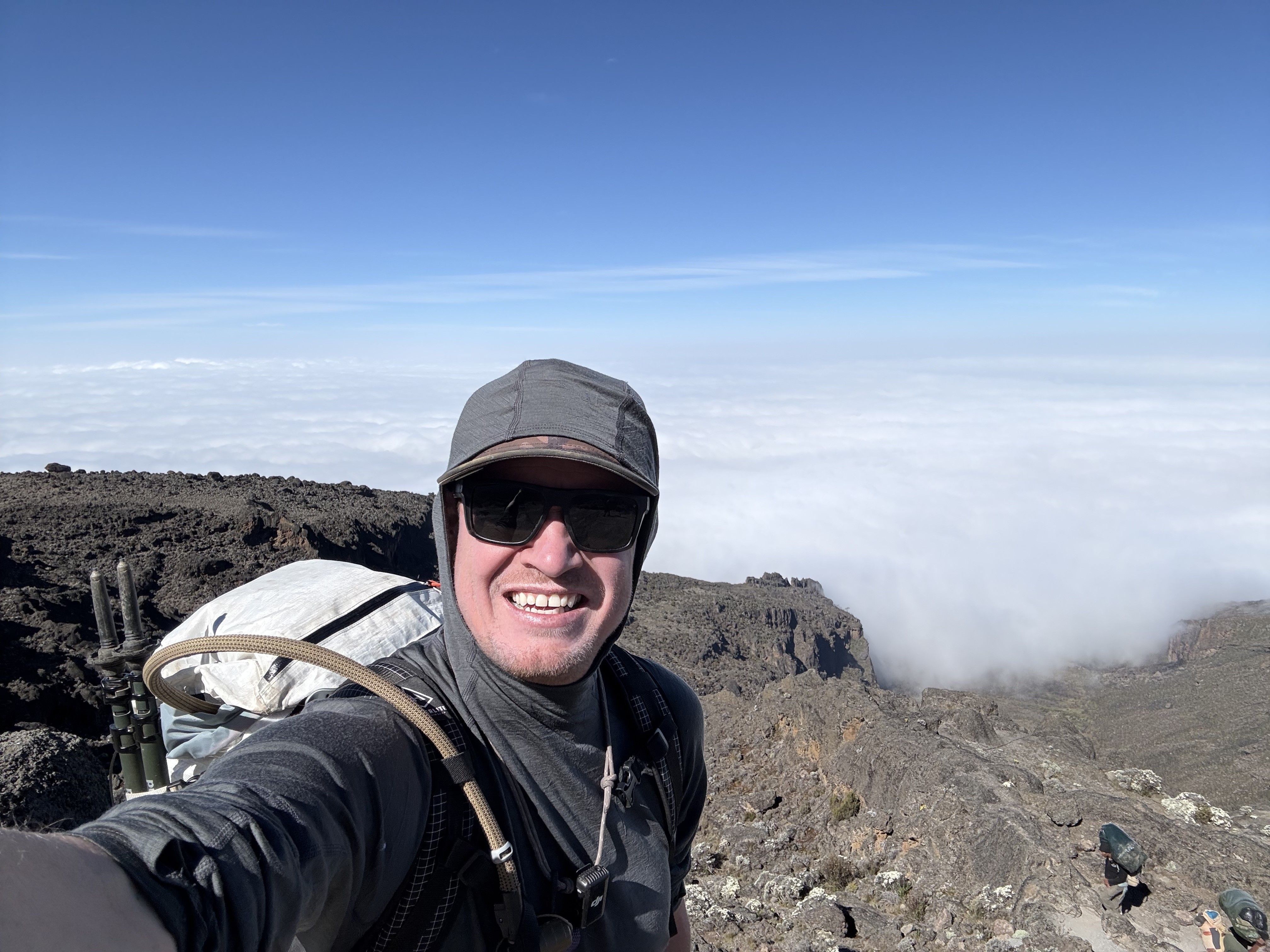
As the days passed, the jungle disappeared behind us and Kilimanjaro began to feel much more like a high mountain.
At some of the higher camps, around 5,000 meters, we’d look out from our tents and see an enormous carpet of clouds stretching below us.
We were completely above them.
Those were some of my favourite moments of the entire climb.
There wasn’t necessarily anything dramatic happening. We’d finished walking for the day, camp was set up and there was time to just stand there and take in where we were.
For sleeping, I had my Sea to Summit Alpine sleeping bag, and during the day I was carrying everything I needed in the Hyperlite Prism.
Eventually, though, the relaxed trekking days were over.
We reached high camp.
The next time we started walking, it would be for the summit.
MIDNIGHT
We started the summit push at around midnight.
I had expected Kilimanjaro to be easier.
At 5,895 meters, it wasn’t particularly high compared with some of the mountains I was beginning to focus on, and I think I’d underestimated how long and tiring the final summit push would actually be.
It turned into a proper night out.
I was wearing Scarpa trekking boots rather than high-altitude mountaineering boots, with two pairs of socks to keep my feet warm. I had my Mountain Hardwear Ghost down pants, Arc’teryx hard shell and HIMALI Altitude Down Jacket, with my Petzl Actik Core lighting the route ahead.
And we certainly weren’t alone.
July is a busy period on Kilimanjaro, and there must have been around a hundred people attempting the summit that night.
For much of the climb we were working our way past other groups.
Monica was absolutely flying.
She was a beast on summit night and was moving so strongly that she actually beat me to the top.
After hours of climbing through the darkness, the horizon finally began to change.
Morning was coming.

SUNRISE OVER AFRICA
We reached Stella Point at 5,756 meters as the sun was beginning to rise.
From there, the route continues around the crater rim toward Uhuru Peak.
I was cold.
I was tired.
But I remember stopping for a couple of minutes and just watching.
The sun was coming up across the African landscape while we stood high above a huge layer of clouds.
After spending most of the night staring at the small circle of light from my headlamp, suddenly the entire landscape opened up around us.
It was spectacular.
Then we started the final traverse toward Uhuru Peak.
The highest point in Africa was just ahead.
THE ROOF OF AFRICA
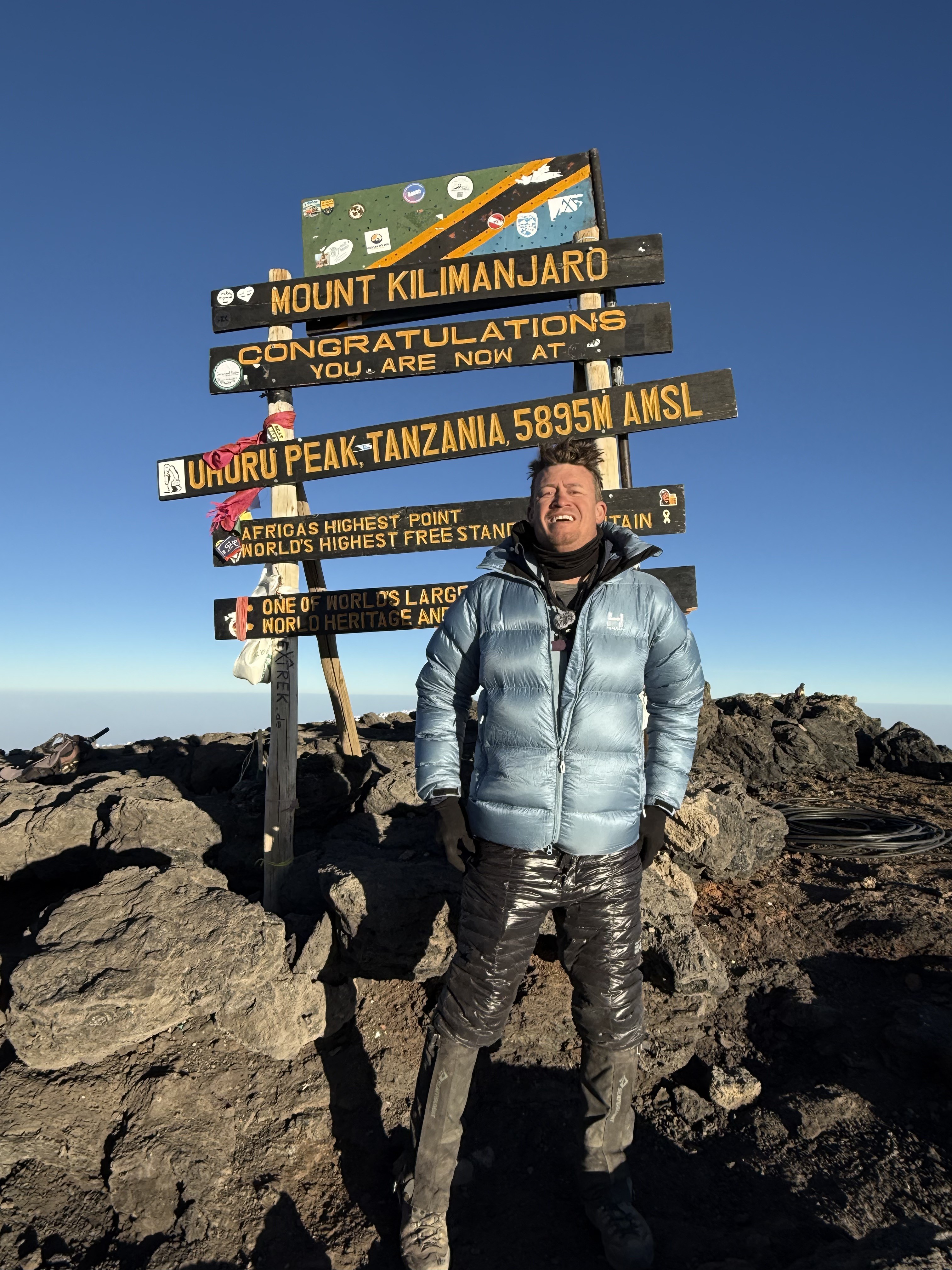
On the morning of July 4, 2025, Monica and I reached Uhuru Peak at 5,895 meters.
I remember sitting down for a moment.
I was exhausted, but there was also that simple realization:
I’m sitting on the highest point in Africa.
It was pretty cool.
Then came the summit photographs.
Unfortunately, after spending the entire night climbing, apparently neither exhaustion nor altitude was particularly good for my photography skills.
The photos were terrible.
So at some point I’m going to have to climb Kilimanjaro again, if only to get a decent summit photo and work on my summit poses.
For now, though, we still had a very long way to descend.
We dropped all the way back to high camp and then continued farther down the mountain, losing a huge amount of altitude in a single day. It meant our final day was comparatively easy, with just a short walk remaining to get out of the park.
After seven days on Kilimanjaro, we returned to Moshi and spent another couple of days there before it was time for me to move again.
I flew from Tanzania to Turkey and then onward to Geneva.
Africa was finished.
Next stop: Chamonix and the Alps.


FIELD NOTES / PHOTOGRAPHS
FROM THE EXPEDITION

Moshi
Back on the Plains

Killimanjaro
Sunrise from Kilimanjaro

Kilimanjaro
Wildlife on the Lower Slopes

Base Camp Bath Day 😂

High Camp on Kilimanjaro
High Camp on Kilimanjaro

Waterfalls of Kilimanjaro

Kilimanjaro
Tanzania Beyond the Mountain

Lava Tower
MOUNTAIN DETAILS
ALTITUDE
5,895
M
COUNTRY / REGION
Tanzania
ROUTE
Lomsho
OPERATOR / GUIDE
CONTINENT
Africa
MOUNTAIN RANGE
Eastern Rift Mountains
https://youtu.be/YpmlRBd8vhQ
